


You’ve tried everything.
You’ve had the calm conversations. The emotional ones. The angry ones. You’ve hidden bottles. Checked backpacks. Watched bank statements. Stayed awake later than you should just to hear the front door open.
And still, something feels out of control.
If you’re searching for professional support for alcohol use, it’s likely because you’ve reached a point where love — as powerful as it is — doesn’t feel like enough anymore.
For many families in Howard County, Maryland, that realization comes quietly. A parent sitting at the kitchen table after everyone’s asleep, wondering how it got here.
For others in Carroll County, Maryland, it hits all at once — a hospital visit, a phone call, a moment that makes your stomach drop.
Wherever you are in this, hear this clearly:
You did not cause this.
And you are not failing.
But there are things treatment can do that even the most devoted parent cannot.
You Can Love Them — But You Can’t Regulate Their Brain
Alcohol changes the brain.
It affects impulse control, mood regulation, decision-making, and the stress response. When your young adult is drinking heavily, they are not operating from the same neurological baseline they once had.
At home, you’re responding to behaviors — the irritability, the secrecy, the unpredictability.
In a structured environment, clinicians are working directly with the nervous system. Through therapy, skill-building, accountability, and in some cases medication support, we help stabilize what alcohol has destabilized.
Love provides comfort.
Clinical care provides regulation.
They work together — but they are not interchangeable.
You Can Set Rules — But You Can’t Break the Pattern Alone
You may have tried:
“No drinking in this house.”
“If this happens again, there will be consequences.”
“We can’t keep living like this.”
And maybe for a few days, it worked.
Then something triggered them — stress, loneliness, shame — and the cycle restarted.
Alcohol use rarely exists in isolation. It often overlaps with anxiety, depression, trauma, identity confusion, or when mental health and substance use collide.
At home, you see the surface behavior.
In treatment, we explore what’s underneath it.
Until those drivers are addressed, patterns tend to repeat — even in loving, stable homes.
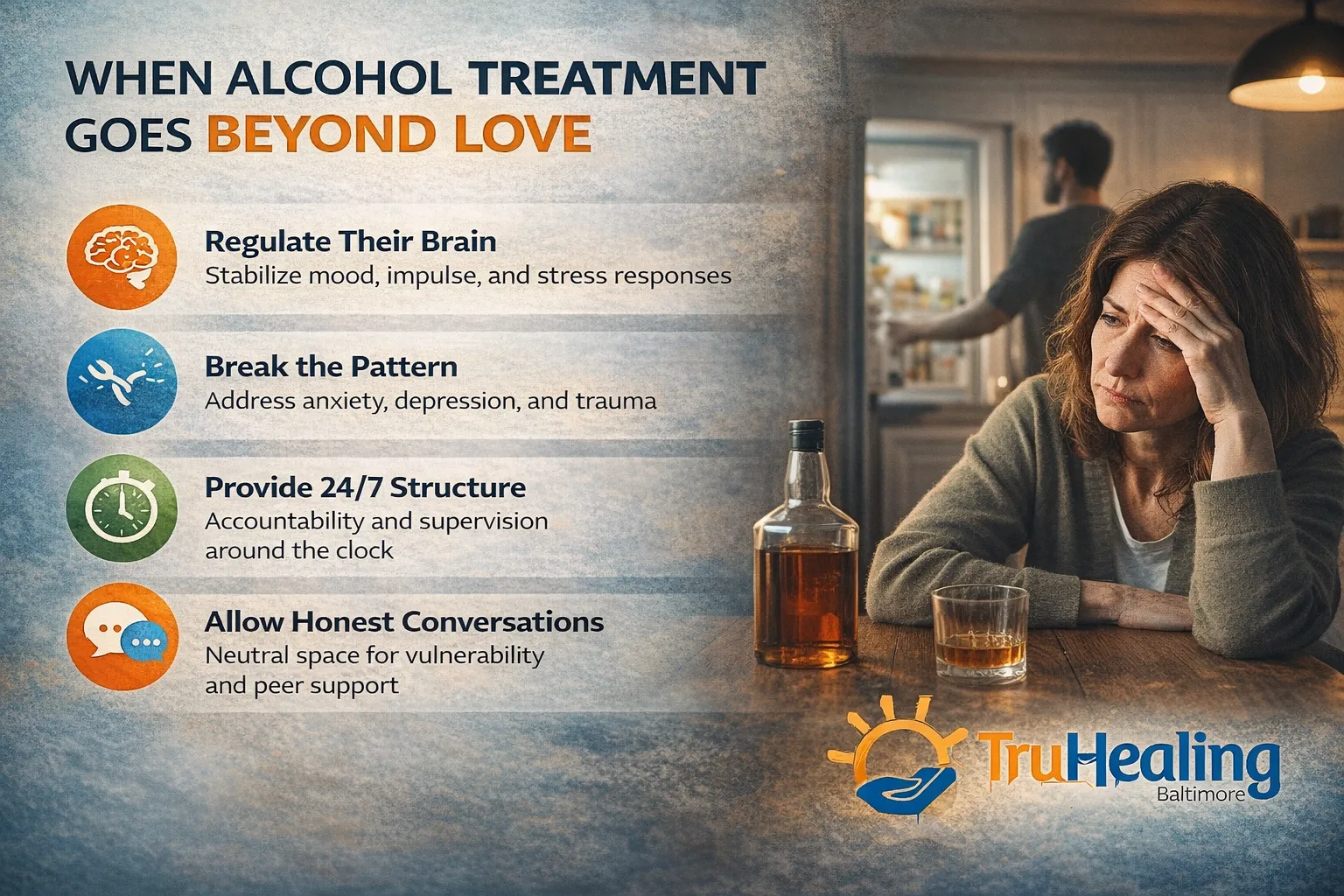
You Can Watch Closely — But You Can’t Provide Structure Around the Clock
Parents in crisis often become hyper-vigilant.
You listen for footsteps.
You check their eyes.
You scan for mood shifts.
It’s exhausting.
And even with all that vigilance, there are still hours you can’t monitor. You have to sleep. Work. Step away.
In more intensive levels of care — whether structured daytime care or round-the-clock support — there is built-in accountability and supervision. There are clinical teams trained to notice subtle shifts before they escalate.
Structure is not punishment.
For many young adults, it’s relief.
When the chaos of drinking is interrupted by routine, something steadier has room to grow.
You Can Ask Questions — But You Can’t Be Neutral
This is one of the hardest truths for parents to hear.
You are not just a caregiver.
You are their mother. Their father. Their safe place. Their history.
When you ask, “Have you been drinking?” it lands differently than when a therapist asks.
With you, it carries fear, disappointment, years of shared experience.
In treatment, your young adult can speak honestly without feeling like they are shattering your heart in real time.
That emotional distance allows vulnerability.
And vulnerability allows change.
You Can Encourage — But You Can’t Replace Peer Connection
Young adults often minimize their drinking at home. They insist it’s normal. That everyone their age drinks this way.
In group settings, they meet others whose stories mirror their own — the blackouts, the broken promises, the anxiety masked as confidence.
There’s a moment that happens in groups sometimes.
A young adult says, “I thought I was the only one.”
That moment matters.
Isolation feeds addiction.
Connection weakens it.
As much as your support matters, peers can reach places parents simply can’t.
You Can Hope — But You Can’t Create Internal Motivation
You cannot want recovery more than they do.
You can beg. You can bargain. You can threaten consequences.
But sustainable change comes from internal motivation.
Treatment environments are designed to help young adults examine their own choices — not through lectures or shame, but through reflection, accountability, and guided conversation.
We’ve seen resistant clients arrive defensive and leave saying, “I didn’t realize how much I was losing.”
That shift cannot be forced at home.
It has to be discovered.
What Happens Inside Treatment That’s Hard to Create at Home
When families reach out for Alcohol addiction treatment, they often assume the focus is simply on stopping drinking.
It’s deeper than that.
Inside a therapeutic environment, young adults:
- Learn to identify emotional triggers.
- Practice coping skills in real time.
- Develop routines that don’t revolve around alcohol.
- Receive honest feedback from clinicians and peers.
- Rebuild self-trust through small, consistent actions.
We also work with families — helping you understand what’s happening neurologically and emotionally, and how to support recovery without carrying it alone.
This is not about replacing you.
It’s about reinforcing you.
Success Stories Often Start Small
Parents sometimes expect dramatic transformation.
And sometimes that happens.
But more often, progress looks like this:
A young adult who once denied everything begins acknowledging patterns.
Someone who avoided therapy begins participating.
A family that could only argue begins speaking calmly for ten minutes at a time.
One parent told us, “For the first time in a year, I’m not afraid to leave the house.”
Another said, “They looked me in the eye and told me the truth.”
Those moments are not small.
They are foundations.
When It Feels Like You’re Losing Them
Perhaps the most painful part of this is the fear.
You may worry about their safety. Their health. Their future.
You may wonder if one more incident will push things too far.
If you feel like you’re slowly losing your child to alcohol, that fear deserves to be taken seriously.
Reaching out for outside support does not mean giving up.
It means acknowledging that this is bigger than a household can manage alone.
It means choosing stabilization over survival mode.
And sometimes, that’s the most loving act of all.
Frequently Asked Questions
How do I know if this is serious enough for treatment?
If alcohol use is affecting your young adult’s mood, behavior, relationships, academics, or safety, it’s worth a professional evaluation. You don’t need a catastrophic event to justify support.
What if they refuse to go?
Resistance is common. Sometimes beginning with a clinical assessment or structured conversation can open the door. We can guide families through those first steps.
Will this permanently label them?
Seeking support is not a life sentence. It’s an intervention. Many young adults stabilize, learn tools, and return to school or work with renewed clarity.
How involved can we be as parents?
Family involvement is often a key part of the process. We provide guidance on boundaries, communication, and how to support recovery without enabling.
What if they’ve tried before and relapsed?
Relapse does not erase progress. Many young adults require multiple attempts before lasting change takes hold. Each attempt builds insight and skill.
You have done everything you know how to do.
If loving them fiercely hasn’t shifted the pattern, it doesn’t mean you’ve failed.
It may mean it’s time for additional support.
Call 833-782-2241 or visit our Alcohol addiction treatment services to learn more.