


I used to say it with confidence.
“Treatment didn’t work for me.”
I said it like a final answer. Like I had proof.
But if I’m honest now, that wasn’t the whole story.
When I first went through alcohol recovery support, I walked out convinced it hadn’t changed anything. I still struggled. I still drank again. I still felt stubborn and skeptical.
So I labeled it a failure.
It was easier than admitting something uncomfortable:
Something in me had shifted.
For a lot of people across Baltimore County, Maryland, that sentence — “It didn’t work” — becomes a shield. And for others in Anne Arundel County, Maryland, it becomes a quiet excuse not to try again.
I get that. I really do.
Because I used it too.
I Wanted Immediate Proof
Here’s the truth: I wanted a transformation.
I wanted to walk out clear-headed, craving-free, grateful, and confident. I wanted fireworks. I wanted certainty. I wanted to feel “fixed.”
Instead, I left with mixed feelings.
I had tools.
I had new language.
I had moments of clarity.
But I also had resistance. Doubt. A part of me that still wanted to drink.
So I decided it hadn’t worked.
Because if it didn’t feel dramatic, I assumed it wasn’t real.
What I didn’t understand then is this: growth is rarely cinematic. It’s usually inconvenient and subtle.
The Things I Pretended I Didn’t Learn
Months later, I caught myself doing things differently.
Pausing before reacting.
Recognizing a trigger instead of denying it.
Hearing the internal voice that said, “This is about more than alcohol.”
I didn’t connect those moments back to treatment at first.
But they weren’t random.
Even though I had returned to old habits, something in me had been exposed to new information. Once you see your patterns clearly, you can’t fully unsee them.
It’s like someone adjusted the lighting in a room. You can still pretend not to notice the dust, but you know it’s there now.
That knowledge stays with you.
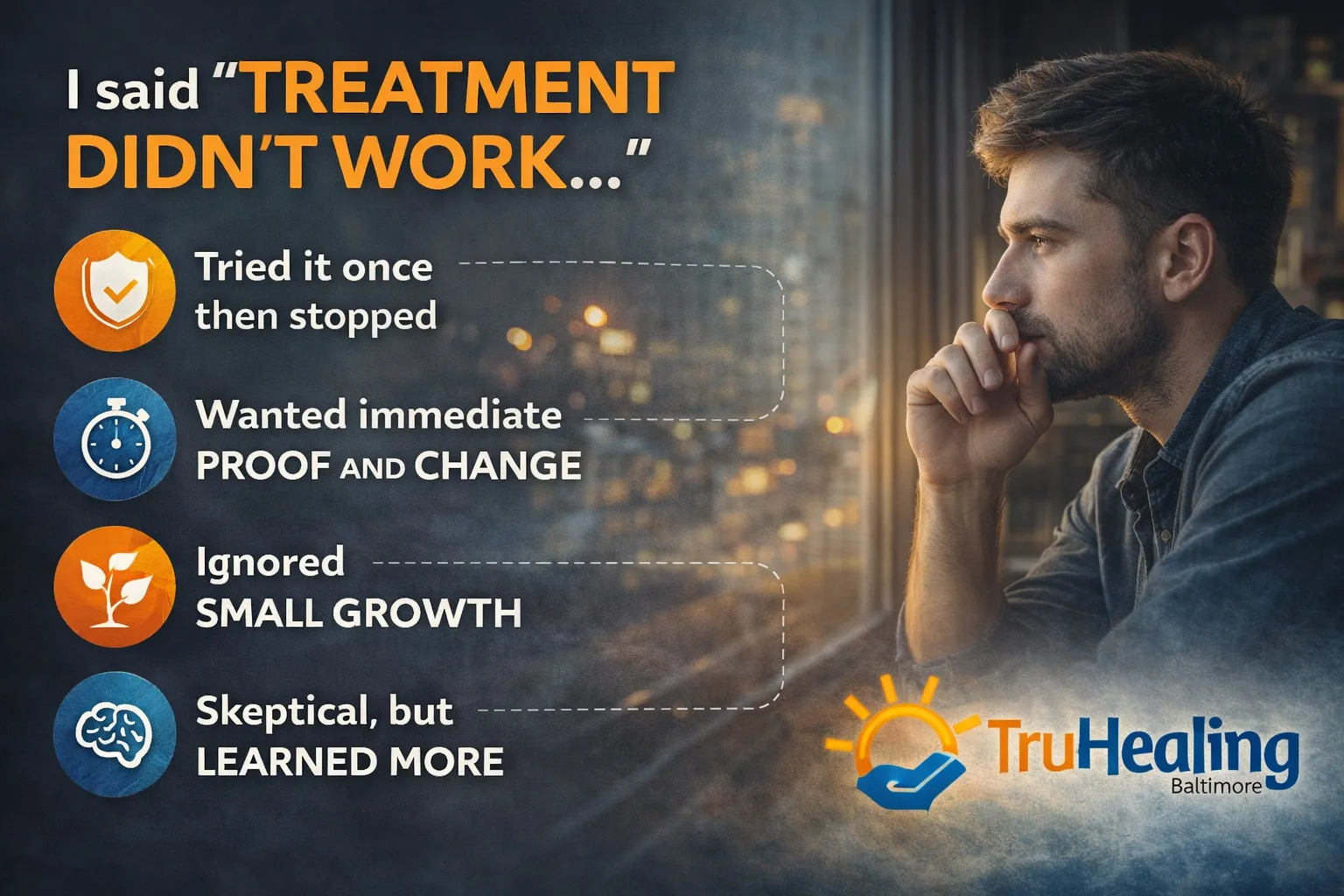
“It Didn’t Work” Sometimes Means “I Didn’t Want It To”
This is the part that stings.
Sometimes when we say something didn’t work, what we really mean is:
I wasn’t ready.
I didn’t like what I heard.
I didn’t want to let go yet.
And that’s not a moral failure. It’s human.
Letting go of alcohol isn’t just about stopping a behavior. It’s about changing identity, coping mechanisms, social rhythms, even how you deal with stress or loneliness.
That’s huge.
Of course part of you resists.
But resistance doesn’t cancel out impact.
It just slows it down.
Progress Isn’t Always Visible Right Away
When people talk about success stories, they usually skip the messy middle.
They don’t talk about the times they left and came back. The times they relapsed but noticed it faster. The times they didn’t spiral as far.
The first time I sought Alcohol addiction treatment, I relapsed afterward. That was my proof it hadn’t worked.
But the relapse looked different.
It didn’t last as long.
I felt the consequences more clearly.
I reached out sooner.
I couldn’t pretend I didn’t know what I was doing anymore.
That awareness — as uncomfortable as it was — was progress.
It just didn’t look like the kind of progress I thought I needed.
Treatment Planted Seeds I Tried to Ignore
Think of it this way.
You can plant seeds in dry soil and walk away, convinced nothing will grow.
But sometimes, weeks later, something breaks the surface.
Treatment gave me language for things I had never named:
- Shame
- Avoidance
- Emotional numbing
- Fear of being fully seen
I didn’t want those insights at first.
But they stayed with me.
Even when I drank again, I couldn’t drink the same way. I knew what I was avoiding. I knew what I was covering.
And once you know that, it changes everything.
The Myth of “All or Nothing”
One of the biggest traps I fell into was thinking recovery had to be absolute to count.
If I wasn’t completely sober, it was a failure.
If I still struggled, it was a failure.
If I didn’t love every part of the process, it was a failure.
That thinking kept me stuck.
Recovery isn’t binary.
It’s directional.
Even if you take two steps forward and one step back, you’re not at the starting point anymore.
You’re somewhere new.
And that matters.
Why Skepticism Makes Sense
If you’re skeptical, I respect that.
Maybe you tried structured daytime care and felt disconnected. Maybe multi-day weekly treatment felt repetitive. Maybe you didn’t connect with a counselor. Maybe you weren’t honest the first time.
All of that happens.
Treatment isn’t magic.
It’s not supposed to override your free will or erase your personality.
It’s supposed to give you tools, perspective, and support.
What you do with that afterward is still yours.
But even if you don’t use everything right away, exposure changes you.
The Part I Couldn’t Go Back From
There was a moment — long after I’d declared treatment useless — when I realized something uncomfortable.
I couldn’t fully enjoy drinking the way I used to.
Not because I was morally superior. Not because I was suddenly enlightened.
But because I understood what it was costing me.
I knew what my triggers were. I knew how I used alcohol to escape conversations, stress, boredom, insecurity.
That awareness followed me.
And eventually, it wore me down in a good way.
I didn’t go back because I failed less.
I went back because I knew more.
It’s Okay If You’re Not Ready — Yet
If you’re reading this thinking, “Yeah, I tried. It didn’t help,” I won’t argue with you.
Maybe you didn’t feel transformed. Maybe you didn’t leave glowing with gratitude.
But ask yourself this quietly:
Did you learn anything?
Did you see anything about yourself more clearly?
Did a part of you feel understood for the first time?
If the answer is yes — even a small yes — then something worked.
It just might not have finished its work yet.
The Door Is Easier to Reopen
Here’s something no one told me:
The first time is often about exposure. The second time is about willingness.
Once the door has been opened, even briefly, it’s easier to step through again.
You know what to expect.
You know what parts felt helpful.
You know what didn’t.
You’re not starting from zero.
You’re starting from experience.
And experience counts.
FAQs
What if I already tried and relapsed?
Relapse doesn’t erase what you learned. Many people return with deeper insight and stronger motivation the next time. Treatment is not invalidated by struggle — it’s often strengthened by reflection.
How do I know if it’s worth trying again?
If you’re still thinking about it, that’s information. Lingering curiosity or discomfort often signals unfinished work, not failure.
What if I didn’t connect with my last program?
Connection matters. Different settings — structured daytime care, multi-day weekly treatment, or round-the-clock support — offer different experiences. A better fit can change everything.
What if I’m embarrassed to come back?
You’re not the first person to return. Not even close. Many people step away and come back with more clarity. There’s no penalty for that.
What if I’m still skeptical?
You’re allowed to be. Skepticism doesn’t disqualify you. You don’t have to believe 100% for something to help you. Sometimes openness grows after you step back in — not before.
If you once said it didn’t work, you’re not alone.
I said it too.
But when I look back, I can see it clearly now: something had shifted. It just didn’t look the way I expected.
If you’re considering giving it another look — or simply exploring what might feel different this time — call 833-782-2241 or visit our Alcohol addiction treatment services to learn more.