

Home » Substance Abuse Treatment » Opiate & Opioid Addiction Treatment » 7-Hydroxymitragynine
7-hydroxymitragynine—often called 7-OH—is a powerful compound found in kratom that is gaining attention for its opioid-like effects and addiction potential. While kratom is often marketed as a natural supplement, certain extracts—especially those high in 7-OH—can behave very differently in the body.
For some people, what starts as occasional use can quickly shift into tolerance, dependence, and withdrawal.
If you or someone you love is struggling with kratom or 7-OH use, it’s important to understand what’s happening—and what help is available.
At TruHealing Baltimore, we provide medical detox, residential care, and outpatient programs to support recovery from emerging substances like 7-OH and other opioids.
7-hydroxymitragynine is one of the most active compounds found in kratom leaves. While kratom contains multiple alkaloids, 7-OH is considered one of the strongest and most pharmacologically active.
It interacts with the brain in a way that is similar to opioids by:
Because of this, higher concentrations—especially in extracts, shots, or enhanced powders—can significantly increase the risk of misuse.
7-hydroxymitragynine is one of the most active compounds found in kratom leaves. While kratom contains multiple alkaloids, 7-OH is considered one of the strongest and most pharmacologically active.
Not all kratom products are the same.
Many newer products are specifically formulated to increase 7-OH concentration, making them far more potent than traditional kratom powder.
This can lead to:
For many individuals, this is the point where use shifts from casual to difficult to control.
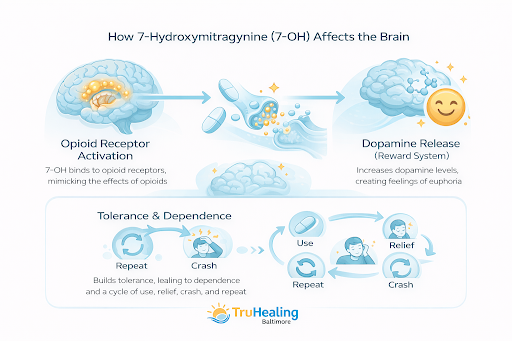
7-OH affects many of the same systems as opioids:
Short-term effects:
Long-term effects:
Over time, the brain begins to rely on the substance to regulate mood and function—making it harder to stop without support.
It’s not always obvious when use becomes a problem.
Some common signs include:
If this sounds familiar, it may indicate physical or psychological dependence.
If you’re recognizing these signs in yourself, you’re not overreacting—and you’re not alone.
Early support can make stopping safer and more manageable.
Stopping 7-OH can lead to withdrawal symptoms similar to opioids.
These may include:
Withdrawal can be uncomfortable—and in some cases overwhelming—making relapse more likely without support.
A medical detox program can help manage symptoms safely and reduce risk.
If you’re struggling with 7-OH or kratom use, you’re not alone—and recovery is possible.
A medically supervised detox for kratom and opioid withdrawal can help stabilize symptoms safely
After detox, many individuals benefit from residential addiction treatment in Baltimore for deeper healing.
Daytime treatment with intensive therapeutic support while transitioning out of inpatient care. A partial hospitalization program for addiction recovery provides structured care during the day.
As stability improves, a flexible outpatient addiction treatment program can help maintain progress. Flexible treatment that allows you to continue recovery while maintaining daily responsibilities.
Long-term strategies to maintain recovery and prevent relapse.
Every treatment plan is personalized—because no two recovery journeys are the same.
You don’t have to wait until things get worse.
It may be time to reach out if:
Early support can make recovery more manageable—and more sustainable.
You don’t have to figure this out alone.
TruHealing Baltimore provides compassionate, evidence-based care for individuals struggling with substance use and co-occurring mental health conditions.
Locations in Windsor Mill & Baltimore
Take the first step today—healing starts with reaching out.
Early support can make stopping safer and more manageable.