

Most people researching treatment while still working aren’t doing it from a hospital bed.
They’re doing it between meetings.
Between school pickups. Between client calls. Between pretending they’re “just tired” for the hundredth time.
A lot of high-functioning people search for help late at night with one tab open for work and another open for treatment options they hope nobody ever sees in their browser history.
They’re not asking, “Do I need help?”
Usually, deep down, they already know.
What they’re asking is:
“How badly will getting help disrupt my life?”
If you’re exploring structured daytime treatment options while trying to hold onto your career, relationships, or reputation, you are far from the only person asking those questions.
And honestly? The fact that you’re functioning doesn’t mean you’re okay.
High-Functioning Struggles Are Easy to Hide—Until They Aren’t
One of the biggest misconceptions about addiction and mental health treatment is that everyone seeking help is visibly falling apart.
That’s rarely true.
Some people entering treatment are still:
- showing up to work every day
- paying bills on time
- making presentations
- parenting their kids
- answering texts
- going to the gym
- smiling at dinner
From the outside, their life still “works.”
But internally, it can feel like holding together a collapsing ceiling with one shaking hand.
As clinicians, we often meet people who’ve spent years convincing themselves they can’t possibly need treatment because they’re still productive. They compare themselves to stereotypes instead of paying attention to their own exhaustion.
But functioning is not the same thing as being healthy.
A person can succeed professionally while privately unraveling emotionally.
And eventually, the body starts keeping score.
The Real Fear Usually Isn’t Treatment—It’s Losing Control
People often frame their questions around cost because it feels safer than talking about fear.
It’s easier to ask:
“How much does this cost?”
Than:
“What if people find out?”
“What if I can’t handle treatment?”
“What if I stop using and still feel miserable?”
“What if I lose the version of myself everyone depends on?”
Those fears are common, especially among high-achieving adults.
Many people have built entire identities around reliability and performance. Admitting they need help can feel emotionally dangerous. Like pulling one loose thread from a sweater they’ve spent years stitching together.
That’s why conversations about day treatment cost maryland are often about much more than finances.
People are trying to understand whether recovery can fit inside real life.
So…How Much Does Structured Daytime Care Actually Cost?
The honest answer is: it varies.
In Maryland, the cost of structured daytime treatment depends on several factors, including:
- insurance coverage
- deductible amounts
- treatment frequency
- psychiatric or medical support needs
- medication management
- transportation availability
- length of stay in care
Some people assume treatment automatically means massive out-of-pocket costs. That’s not always true.
Many treatment programs work with insurance providers, and some individuals end up paying far less than they expected after benefits are verified.
But here’s another truth people don’t always calculate:
Untreated addiction and mental health struggles already come with a price tag.
Sometimes it looks like:
- missing work because of burnout
- drinking more to sleep
- emotional withdrawal from family
- constant anxiety hidden behind productivity
- increased medical problems
- lost focus
- panic attacks
- isolation
- career instability masked as “stress”
We’ve had patients tell us they were terrified of paying for treatment while quietly spending hundreds every month just trying to hold themselves together.
Alcohol. Pills. Food delivery because they’re too exhausted to cook. Missed opportunities. Impulse spending to numb out. Constant emotional recovery after every workday.
The costs were already there.
Treatment simply made them visible.
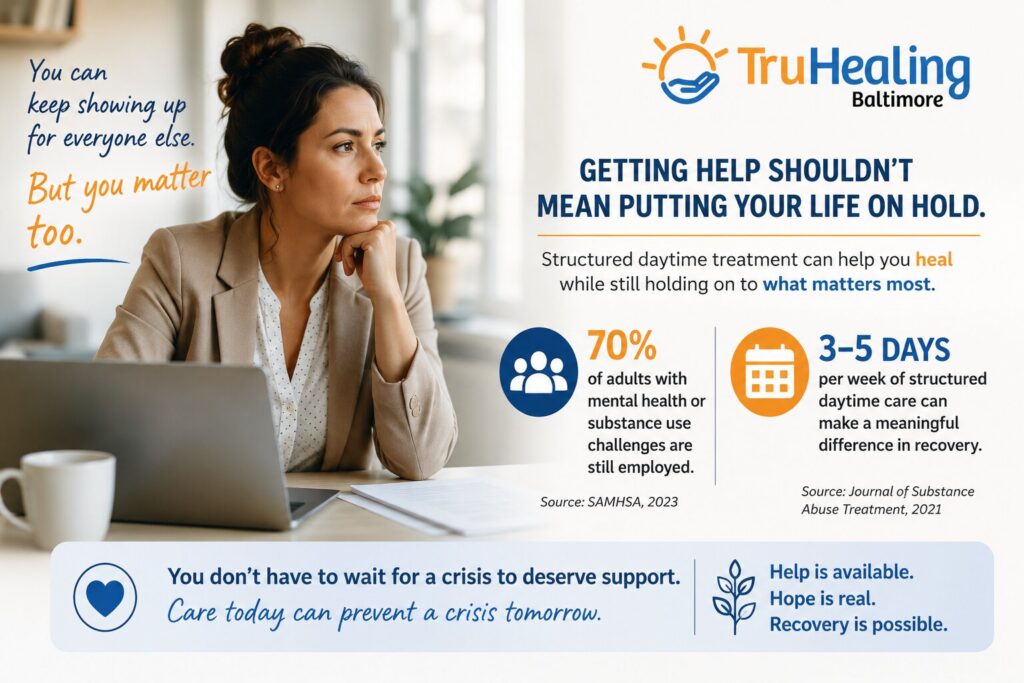
Can You Actually Keep Working During Treatment?
In many cases, yes.
And this is where a lot of people feel surprised.
Not everyone entering structured daytime care disappears from life completely. Some people continue working in limited or modified ways while receiving treatment.
That depends on:
- the severity of symptoms
- your physical safety
- your mental health stability
- job flexibility
- scheduling needs
- whether remote work is possible
- support systems at home
Some people temporarily reduce hours.
Some use FMLA protections or medical leave.
Others continue working evenings or part-time while attending treatment during the day.
There’s no universal formula because people’s lives are different.
What matters most is honesty about capacity.
A lot of high-functioning individuals are technically “keeping up” while emotionally operating on fumes. They’ve normalized stress levels that would flatten most people.
Eventually, even successful people hit a wall.
Not because they’re weak.
Because human beings aren’t machines.
The Myth of “I’ll Go Once Things Get Worse”
This mindset keeps people stuck for years.
Many high-functioning adults believe treatment only becomes justified after:
- losing a job
- getting arrested
- destroying a relationship
- having a medical emergency
- publicly embarrassing themselves
- completely collapsing
But waiting for catastrophe is not strength.
It’s survival mode wearing a business suit.
One of the most painful things clinicians witness is how long people wait simply because nobody around them realizes how bad things have become internally.
Especially with alcohol use.
A person can quietly increase their drinking over years while still appearing “successful.” They may never miss work. Never get a DUI. Never raise alarms.
Meanwhile:
- their nervous system stays constantly overloaded
- sleep deteriorates
- emotional regulation worsens
- anxiety spikes
- depression deepens
- relationships flatten
- joy disappears
Sometimes the only outward symptom is exhaustion so deep it feels cellular.
Treatment Is Often More Practical Than People Expect
People tend to imagine treatment as cold, rigid, or disconnected from real life.
In reality, many programs understand that adults have responsibilities.
Questions about scheduling, transportation, insurance, and flexibility are normal.
Not selfish.
Not superficial.
Normal.
People searching day treatment cost maryland are often trying to figure out logistics quietly before they allow themselves to emotionally consider treatment at all.
They want to know:
- “Can I still take care of my kids?”
- “Will I lose my income?”
- “Can I attend without everyone knowing?”
- “What if I need mental health support too?”
- “How intensive is this really?”
- “What happens if I’m not as okay as I thought?”
Those questions matter because treatment doesn’t happen in a vacuum.
Real people still have mortgages. Responsibilities. Deadlines. Aging parents. Pets. Partners. Entire lives waiting outside the therapy room.
Good care takes that seriously.
High-Functioning People Often Mistake Endurance for Wellness
This is one of the hardest patterns to break.
A lot of successful adults are deeply rewarded for pushing through pain.
They become the reliable one.
The funny one.
The high performer.
The calm one.
The caretaker.
And over time, they lose track of where the performance ends and the actual person begins.
Substances often slide quietly into that gap.
Not always for partying.
Sometimes for survival.
To sleep.
To slow down.
To feel confident.
To tolerate loneliness.
To stop overthinking.
To feel “off” less often.
That’s why treatment isn’t about punishment or losing your identity.
Good treatment helps people reconnect with themselves underneath the coping strategies that stopped working.
Many people are shocked to realize recovery doesn’t make them less capable.
It makes them less exhausted.
You Don’t Need to Earn the Right to Ask for Help
This matters.
You do not need:
- a public breakdown
- severe withdrawal symptoms
- legal consequences
- family ultimatums
- homelessness
- complete life destruction
You don’t need to “prove” your pain first.
Sometimes the clearest sign someone needs help is simply this:
They are profoundly tired of carrying their life the way they currently are.
That counts.
And despite what shame tells people, getting help early is not dramatic.
It’s intelligent.
FAQ: What People Quietly Want to Know About Structured Daytime Treatment
Can I work remotely while attending treatment?
Some people can continue remote or part-time work depending on their treatment schedule and clinical needs. It’s important to be realistic about your stress level and emotional capacity rather than forcing yourself to maintain unsustainable routines.
Does insurance usually cover treatment in Maryland?
Many insurance plans provide coverage for structured daytime care, though benefits vary significantly. Coverage often depends on medical necessity, deductibles, co-pays, and provider networks.
Is treatment confidential?
Yes. Treatment programs are legally required to protect patient privacy. Many professionals worry about employers or colleagues finding out, but confidentiality laws are strict.
What if I’m not “bad enough” for treatment?
This is one of the most common concerns clinicians hear. You do not need to hit a stereotypical rock bottom to deserve support. If substance use or mental health struggles are affecting your quality of life, relationships, emotional stability, or functioning, it’s worth having a conversation.
Can treatment help with anxiety and burnout too?
Absolutely. Many high-functioning individuals entering treatment are dealing with overlapping issues like anxiety, depression, trauma, chronic stress, or emotional exhaustion alongside substance use.
What if I start treatment and realize I need more support?
That happens more often than people think. A quality treatment team can help adjust your care plan based on what you actually need—not what you assumed you could handle alone.
Is asking about cost normal?
Completely normal. Financial concerns are real, especially for working adults supporting themselves or families. Asking practical questions doesn’t mean you’re avoiding recovery. It means you’re trying to understand how to make treatment possible.
You don’t have to keep white-knuckling your way through life just because you’ve gotten good at hiding the strain.
Call (833) 782-2241 or visit TruHealing Baltimore’s partial hospitalization program services to learn more about treatment options, insurance coverage, and what getting help can realistically look like.