

There’s a particular kind of exhaustion parents feel when relapse keeps happening.
Hope rises when your child agrees to get help. You see glimpses of the person you know they can be. Then weeks—or months—later, the phone rings again.
Another setback. Another crisis. Another moment where your heart drops into your stomach.
If you’re reading this, you may be asking the same question many parents quietly ask:
What actually helps when nothing seems to stick?
For some families, the turning point comes when their child enters an environment with round-the-clock support, like live-in treatment, where recovery becomes more than a short pause between relapses.
Before we go further, it’s important to say something clearly.
You didn’t cause this.
You didn’t fail your child.
And the story isn’t over yet.
The Emotional Cycle Many Parents Know Too Well
Parents of young adults in addiction often live on an emotional roller coaster.
Your child may leave treatment determined to stay sober. For a while, things look hopeful.
They reconnect with family. They talk about new plans. They seem motivated to move forward.
Then something shifts.
Stress creeps in. Old friends reappear. Loneliness sets in. A difficult day becomes overwhelming.
And suddenly the progress feels like it disappears overnight.
Each relapse can feel like watching hope slip through your fingers.
Many parents start asking themselves painful questions:
Did we miss something?
Did we do something wrong?
Is recovery even possible anymore?
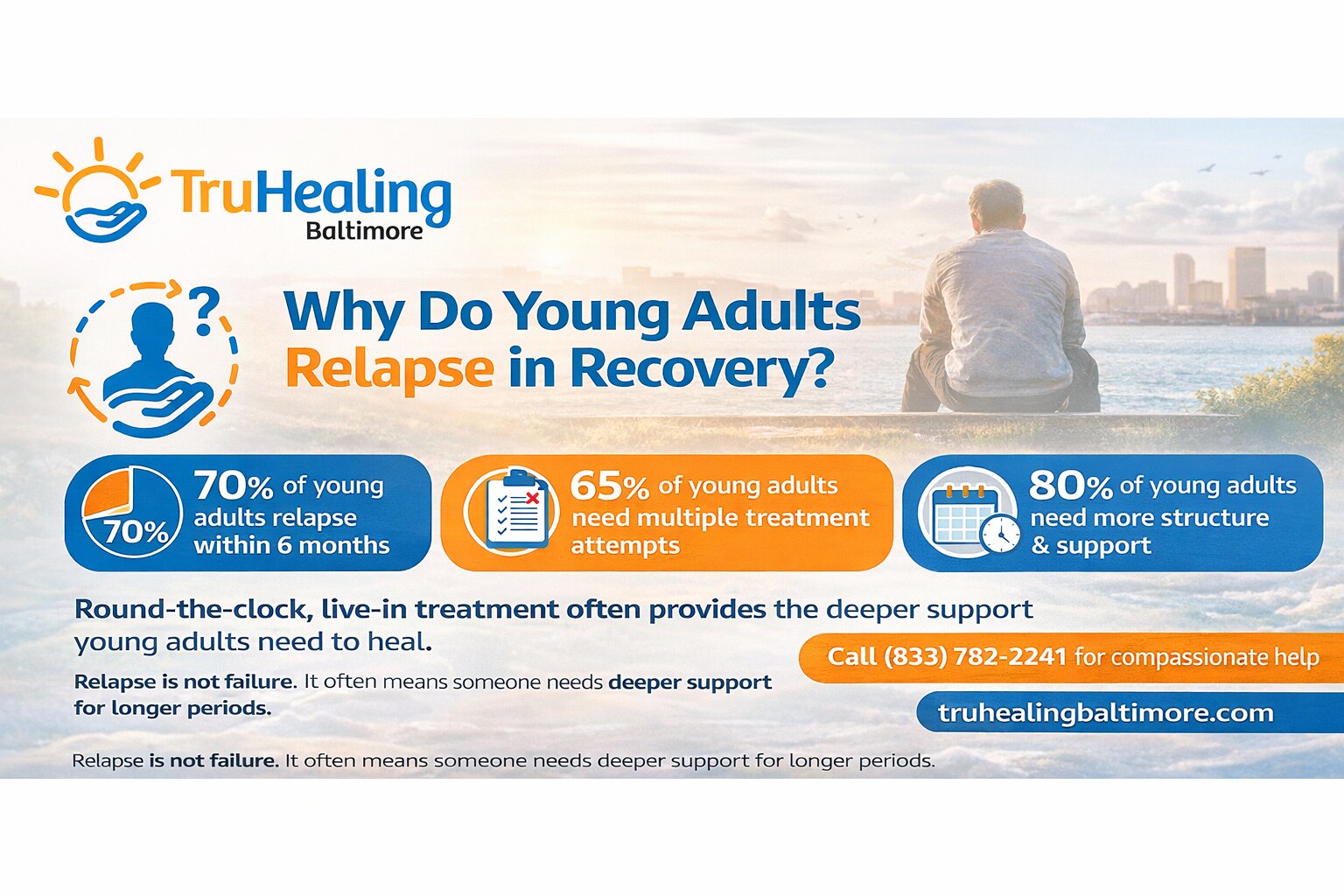
But relapse is not unusual in early recovery—especially for young adults whose brains and emotional development are still evolving.
What relapse often signals is not failure.
It signals that deeper support may be needed.
Why Young Adults Struggle to Stay Sober at Home
Home is full of love.
But it’s also full of reminders.
The same streets, the same social circles, the same stress patterns that existed before treatment are still there waiting when someone returns.
Young adults may also face something many parents don’t fully see:
A fragile sense of identity.
At twenty or twenty-one, life questions can feel overwhelming.
Who am I?
What am I supposed to do with my life?
How do I handle pressure or failure?
Substances often become the quickest way to escape those questions.
When someone returns to the same environment too quickly, it can be difficult to build new coping patterns.
That’s why sometimes the environment itself needs to change before recovery can stabilize.
What Happens When Someone Steps Away From the Chaos
One of the most powerful elements of environments with constant support is something simple:
Distance.
Young adults step away from the pressures that often fuel substance use.
The parties.
The expectations.
The friends who normalize risky behaviors.
Without those constant influences, something begins to shift.
Your child finally has the chance to slow down.
Many young adults entering recovery have never actually paused long enough to understand what they’re feeling.
Inside supportive environments, they begin noticing things they couldn’t see before.
How anxiety builds.
How certain emotions trigger substance use.
How loneliness or shame drives behavior.
This self-awareness is where meaningful change begins.
The Deeper Work That Often Needs to Happen
Parents sometimes worry treatment is simply about telling someone to stop using substances.
But the real work often happens beneath the surface.
Many young adults who struggle with repeated relapse are carrying emotional pain they don’t know how to process yet.
That pain can take many forms:
Anxiety that feels overwhelming
Depression they’ve tried to hide
Trauma they’ve never discussed
Pressure to succeed or meet expectations
Substances temporarily silence those feelings.
But they don’t resolve them.
Recovery environments help young adults face those emotions in a way that feels manageable and safe.
Therapists guide them through conversations they may have avoided for years.
And slowly, the emotional weight that once fueled substance use begins to lift.
The Role of Structure in Early Recovery
Young adulthood is often a time without clear structure.
Schedules change. Responsibilities shift. Freedom increases.
For someone struggling with addiction, that lack of structure can make recovery incredibly difficult.
Structured environments help rebuild a sense of rhythm.
Days become predictable again.
Young adults wake up at consistent times, participate in therapy, build routines, and practice healthier habits.
This rhythm helps the brain stabilize.
Over time, consistency becomes a powerful tool for long-term recovery.
Why Shame Can Make Relapse Worse
By the time a young adult has relapsed multiple times, shame often becomes a major barrier.
They may believe they’ve disappointed their family beyond repair.
They may feel like something is fundamentally wrong with them.
That shame can quietly drive further substance use.
It becomes easier to escape than to face those feelings.
Inside supportive environments, young adults often begin hearing stories from others who struggled in similar ways.
They realize they’re not alone.
That realization alone can weaken the power of shame.
And once shame loosens its grip, hope has room to grow.
What Parents Often Notice When Change Begins
Real recovery rarely looks dramatic at first.
Parents often expect a single breakthrough moment.
But the early signs of progress are usually quiet.
You might notice your child sounding calmer during phone calls.
They may begin talking more openly about emotions instead of shutting down.
They might take responsibility for mistakes rather than blaming others.
These shifts can seem small.
But they often signal something important.
Your child is beginning to believe change is possible.
And belief is where recovery truly begins.
When Hope Slowly Returns
Many parents reach a point where they feel emotionally drained.
You’ve tried so many approaches. You’ve carried worry for so long.
But recovery rarely follows a straight line.
Sometimes the right environment at the right moment creates the space someone needs to grow.
Young adults who once felt lost begin discovering purpose again.
Families who felt powerless begin rebuilding trust.
And slowly, the future begins to feel possible.
It doesn’t happen overnight.
But healing rarely does.
Frequently Asked Questions
Is relapse common for young adults in recovery?
Yes. Relapse can happen during early recovery, especially for young adults who are still learning how to manage emotions, stress, and life transitions without substances.
Why does my child seem motivated in treatment but struggle afterward?
Returning to the same environment can reintroduce triggers and stress patterns. Without enough time to build new coping skills, it can be difficult to maintain progress.
Does relapse mean treatment failed?
No. Relapse often indicates that additional support or a different level of care may be needed. Many people achieve lasting recovery after multiple attempts.
How long does it take for recovery to stabilize?
Recovery timelines vary for every individual. For young adults, progress often occurs gradually as emotional skills, confidence, and stability develop over time.
What role do families play in recovery?
Family support can be incredibly important. Healthy boundaries, education about addiction, and participation in family therapy can all help create a more supportive environment.
Is it too late if my child has relapsed several times?
No. Many individuals who experience multiple relapses eventually achieve long-term recovery once the right support system is in place.
If your family is navigating repeated relapse and searching for new options, compassionate support is available.
Call (833) 782-2241 or explore our treatment programs and live-in treatment options to learn more about our treatment programs and residential treatment programs services.
You don’t have to carry this alone.
And your child’s story is not finished yet.
Many families who once felt hopeless eventually find their way forward—one step, one conversation, and one moment of support at a time.