

At some point, structure starts to feel like something you’ve outgrown.
You followed the plan. You showed up. You did the work. And eventually, you stepped back into your life—more independent, more stable, more “free.”
So when something starts to feel off again, it doesn’t make sense.
You’re not falling apart.
You’re functioning.
But you’re also not… fully there.
If you’re quietly considering something like structured daytime support during the week, it’s probably not coming out of nowhere.
It usually starts as a feeling you can’t quite name.
The Moment Freedom Starts to Feel Like Drift
There’s a version of recovery that looks good from the outside.
You’re doing what you’re supposed to do.
You’re maintaining.
You’re not in crisis.
But inside, it can feel like you’re slowly disconnecting from yourself.
Not dramatically. Not all at once.
Just enough to notice:
- You’re less present
- Things feel flat
- You’re more reactive or more numb
- You’re going through routines without meaning
This is where a lot of long-term alumni get stuck.
Because it doesn’t feel “bad enough” to justify more help.
But it doesn’t feel right either.
The Belief That Keeps People Stuck
There’s a quiet belief that shows up here:
“I shouldn’t need this anymore.”
It’s subtle—but powerful.
It tells you:
- You’ve already done this level of work
- Going back means something didn’t stick
- You should be able to handle this on your own by now
So instead of adjusting support, people often do one of two things:
They push through… or they check out.
Neither one solves the underlying issue.
Because the issue isn’t weakness.
It’s misaligned support.
Why Disconnection Happens Later in Recovery
From a clinical perspective, this phase is incredibly common.
Early recovery is structured. Focused. Supported.
Later recovery? It opens up.
And that openness can create:
- Less accountability
- More exposure to stress
- More internal pressure to “stay okay”
Without realizing it, many people drift into a place where they’re maintaining behavior—but losing connection.
And connection is what actually sustains recovery.
Not just discipline.
The Decision Most People Delay
Here’s the honest part.
Most people notice the shift early.
They feel it:
- In their energy
- In their motivation
- In their relationships
- In their internal dialogue
But they don’t act on it.
They wait.
They tell themselves:
- “It’ll pass.”
- “I just need to push through.”
- “I don’t want to overreact.”
And sometimes, that delay leads to deeper burnout—or a full return of symptoms.
Not because they didn’t know.
But because they didn’t give themselves permission to respond early.
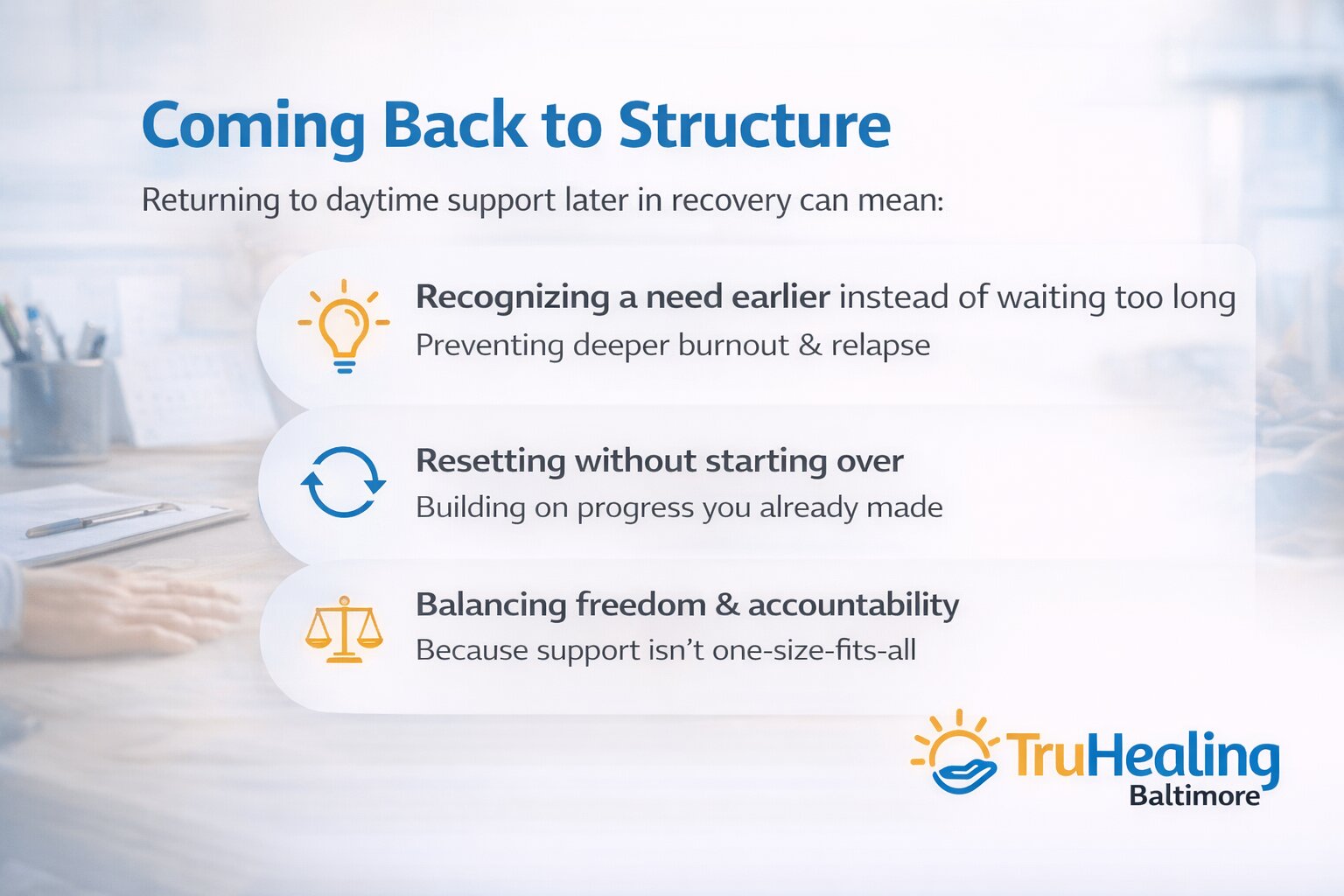
Choosing Structure Again Isn’t Regression
Let’s say this directly:
Coming back to structured care later in recovery is not going backward.
It’s often one of the most self-aware, proactive decisions someone can make.
Because instead of waiting for things to break, you’re recognizing:
This isn’t working the way it used to—and I want to address it now.
We’ve worked with alumni who returned at this stage and said things like:
- “I didn’t want to lose what I built.”
- “I could feel myself slipping emotionally, even if everything looked fine.”
- “I needed something more consistent again.”
That’s not failure.
That’s maintenance with intention.
Structure Isn’t About Control—It’s About Containment
A lot of people resist structured care because it feels restrictive.
But the right structure doesn’t take your freedom.
It stabilizes it.
Here’s a way to think about it:
Freedom without structure can feel like standing in the middle of open space with no direction.
Structure gives you a framework to move within—so your energy has somewhere to go.
It creates:
- Rhythm in your week
- Consistency in your mental health care
- A place to process instead of suppress
And for many long-term alumni, that’s exactly what’s missing.
Not effort. Not willpower.
Just a container strong enough to hold where they are now.
What It Looks Like to Come Back Later in Recovery
Coming back at this stage feels very different than your first time.
You’re not walking in unsure of everything.
You’re walking in with:
- Awareness of your patterns
- Clarity about what you need
- A different relationship with honesty
We often hear:
- “I didn’t fight it this time.”
- “I actually used the space instead of resisting it.”
- “I knew exactly why I was there.”
That shift—from resistance to participation—changes outcomes.
Why This Level of Care Fits the “In-Between”
There’s a gap in recovery that doesn’t get talked about enough.
You’re not in crisis.
But you’re not grounded either.
Weekly therapy might not be enough.
Full-time care might feel like too much.
That’s where structured daytime care becomes relevant.
It provides:
- Multiple days of support each week
- Real-time processing of current challenges
- A balance between independence and accountability
For those exploring options like a mental health day program Baltimore, this level of care often meets that exact in-between space—where something more is needed, but life still needs to continue.
The Risk of Waiting Too Long
Here’s the part that matters most.
Disconnection rarely stays neutral.
Left unaddressed, it tends to:
- Deepen into burnout
- Turn into avoidance
- Or escalate into more serious symptoms
And by the time people seek support again, they’re often more overwhelmed than they needed to be.
Early action doesn’t mean something is wrong.
It means you’re paying attention.
A Different Definition of Strength
There are two kinds of strength in recovery.
One says:
“I can handle this on my own.”
The other says:
“I know when I need more—and I’m willing to choose it.”
The second one is quieter. Less visible.
But clinically, it’s far more sustainable.
You’re Not Starting Over—You’re Adjusting
If you’ve been feeling disconnected, flat, or unsure of your next step, this isn’t the end of your progress.
It might be a signal.
Not to go backward—but to realign forward.
If you’re considering treatment in Baltimore, TruHealing Maryland offers structured care designed for people who aren’t in crisis—but know something needs to shift.
FAQs: Returning to Structured Care Later in Recovery
Is it normal to feel stuck even after long-term recovery?
Yes. Many people experience periods of emotional flatness, disconnection, or burnout after initial stability. It’s more common than people realize.
Does needing more support mean I’m relapsing?
No. Needing support and relapsing are not the same. In fact, seeking support early often prevents relapse.
Why doesn’t weekly therapy feel like enough anymore?
Because your needs may have changed. Sometimes deeper or more consistent support is required to process what’s happening now.
What makes structured daytime care different at this stage?
It offers more consistency and accountability than weekly sessions—without removing you from your daily life.
How do I know if I should step back into more structure?
If you feel disconnected, unmotivated, emotionally flat, or like you’re just going through the motions—it’s worth exploring.
Will it feel like starting over?
Not usually. Most long-term alumni experience it as a reset or recalibration, not a restart.
You Can Choose This Before Things Get Worse
You don’t have to wait until everything falls apart.
You can respond to the subtle shifts—the ones that tell you something isn’t quite right.
That awareness matters.
And acting on it? That’s not weakness.
That’s experience.
Call (833) 782-2241 or visit our treatment programs, partial hospitalization program services in Baltimore, Maryland to learn more about our treatment programs, partial hospitalization program services in Baltimore, Maryland.
And just to leave you with this:
Needing structure again doesn’t mean you’ve lost your progress.
It might mean you’re ready to protect it.