
You might think this has to be one big, brave moment.
A dramatic decision. A clean break. A version of you who feels absolutely certain.
But most people who reach out to us don’t feel brave. They feel overwhelmed. They feel exposed. They feel unsure if they even trust themselves anymore.
If you’re considering Alcohol addiction treatment, it may help to hear this clearly:
Recovery is rarely one heroic leap.
It’s a series of small, steady decisions.
And you only have to make the next one.
For many individuals and families across Baltimore County, Maryland and Anne Arundel County, Maryland, that next decision feels heavy. It can feel like it carries your entire future on its shoulders.
It doesn’t.
It just carries today.
The First Decision Isn’t “Forever”
One of the biggest fears we hear sounds like this:
What if I can’t do this for the rest of my life?
When you’re newly diagnosed, newly honest, or newly confronted with how serious your drinking has become, your mind races forward. You imagine holidays without alcohol. Social events. Stress. Celebrations. Loss. You picture an endless road and wonder if you have the strength to walk it.
But the first decision isn’t about the rest of your life.
It’s about:
- Making a phone call.
- Scheduling an assessment.
- Sitting down and listening.
- Allowing someone to ask you honest questions.
You are not signing a lifelong contract when you reach out. You are choosing a conversation.
And conversations are allowed to unfold.
Fear Is Not a Sign You’re Not Ready
If medication has been suggested, fear can get louder.
“What if it changes my personality?”
“What if I feel flat?”
“What if I lose the edge that makes me… me?”
Those fears are deeply human. Especially if alcohol has been part of your identity—your creativity, your social ease, your coping tool.
We approach medication carefully and collaboratively. You are not expected to hand over control. You are invited into discussion. What’s the goal? What are the options? What feels manageable? What feels scary?
You are allowed to move slowly.
Many people are surprised to learn that medication, when appropriate, doesn’t erase personality. It can quiet the noise—cravings, anxiety, physical dependence—so your real personality has space to breathe.
You don’t disappear in recovery.
You reappear.
Small Decisions Build Quiet Confidence
When people imagine recovery, they often picture dramatic transformation.
In reality, it usually looks like this:
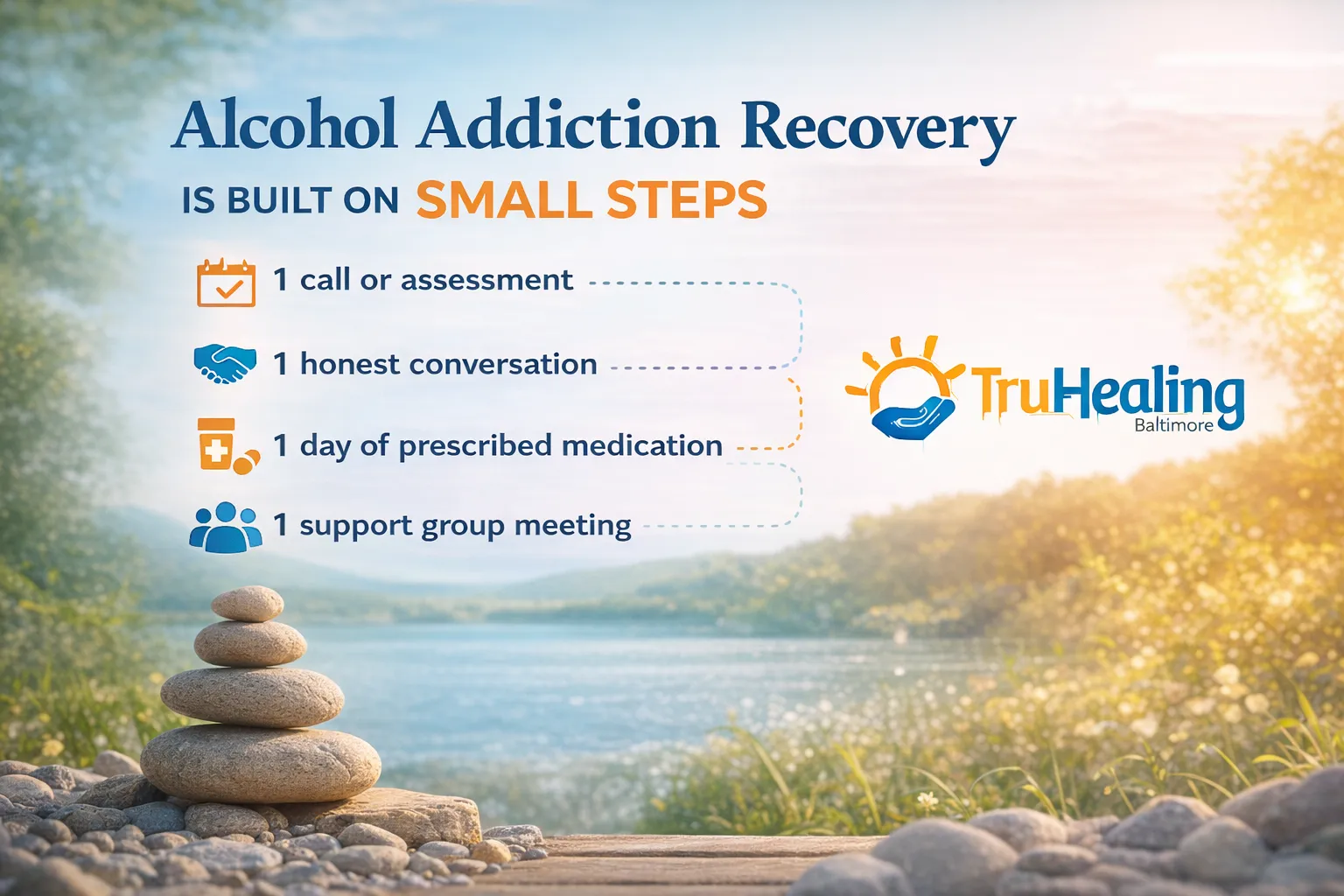
- Showing up to your first group even though your stomach is tight.
- Being honest in therapy instead of minimizing.
- Taking prescribed medication for one week and noticing how your body responds.
- Telling a trusted person the truth.
- Saying, “I need help today.”
None of those are headline-worthy moments.
But they matter.
Think of it like stacking stones. One small stone at a time. At first, it looks fragile. Over weeks and months, you look back and realize you’re standing on something solid.
Confidence in recovery rarely comes from bold declarations.
It comes from kept promises—especially the small ones.
You Don’t Have to Feel Certain to Begin
Many people wait to feel sure.
Sure that they’re ready.
Sure that it will work.
Sure that they won’t fail.
That certainty may never come first.
Hope often grows after action—not before it.
We have seen individuals walk in guarded and skeptical. They didn’t believe in treatment. They didn’t trust the process. Some weren’t even sure they wanted to stop drinking entirely.
But they were willing to try one step.
And then another.
That willingness—not certainty—is often what makes change possible.
What Recovery Actually Looks Like Day to Day
It may help to picture something realistic.
Recovery is not constant inspiration. It’s not daily breakthroughs or dramatic emotional speeches.
Often, it’s structured time. Conversations. Reflection. Skill-building. Accountability. Rest.
Depending on your needs, that might include structured daytime care or multi-day weekly treatment that allows you to stay connected to work and family while receiving consistent support.
For others, round-the-clock care creates safety during the earliest, most vulnerable stage.
There is no single right entry point. There is only the level of support that matches where you are.
And that can change over time.
The Fear of Losing Alcohol
There’s another fear people don’t always say out loud:
What if I miss it?
Alcohol may have been:
- A social bridge.
- A stress reliever.
- A numbing agent.
- A ritual.
- A reward.
You are allowed to acknowledge that it served a purpose.
But you are also allowed to outgrow what once helped you survive.
Missing something does not mean you made the wrong choice. It means you are human. Recovery makes space for those complicated feelings instead of pretending they don’t exist.
“What If I Start and Fail?”
This question carries a lot of weight.
“What if I can’t stick with it?”
“What if I relapse?”
“What if everyone is disappointed?”
Relapse, hesitation, second-guessing—these are not uncommon in recovery. They are part of many people’s stories.
Failure in recovery is rarely a dramatic collapse. More often, it’s a moment of returning.
Returning to conversation.
Returning to support.
Returning to honesty.
If you begin Alcohol addiction treatment and struggle, that does not erase the courage it took to start.
It simply means the plan needs adjusting.
And plans can be adjusted.
The Role of Diagnosis
Being newly diagnosed can feel like being labeled.
It can feel final. Heavy. Permanent.
But a diagnosis is not a verdict on your character.
It is information.
Information helps us choose the right level of support. It helps us understand patterns. It helps us respond to your needs rather than guessing.
You are not your diagnosis.
You are a person navigating something difficult.
Why Treatment Feels So Big in Your Head
Your brain is trying to protect you.
Change is uncertain. Alcohol is familiar. Even if it’s hurting you, it’s predictable.
Predictability feels safer than uncertainty.
So your mind might exaggerate:
- “This will change everything.”
- “You won’t recognize yourself.”
- “You’ll lose people.”
- “You’ll never enjoy life again.”
Those thoughts are loud. But they are not prophecies.
Often, what changes most is not your personality—it’s your relationship to stress, emotion, and control.
Many people describe a surprising shift months into recovery: things feel quieter. Less chaotic. More manageable.
Not perfect. Just manageable.
You Don’t Have to Announce It to the World
Another quiet fear is exposure.
“What will people think?”
“Do I have to tell my job?”
“Will my family judge me?”
Treatment can be private. Conversations can be confidential. You decide who knows and when.
You are allowed to protect your dignity while you protect your health.
Seeking help is not a public confession. It is a personal decision.
The Decision You’re Actually Making
When you step back, here’s what you’re really choosing:
Not a lifelong promise.
Not perfection.
Not a guarantee.
You’re choosing support.
You’re choosing to not carry this alone.
You’re choosing to see what life feels like when alcohol isn’t running the show.
That’s it.
And that is enough.
Frequently Asked Questions
How do I know if I truly need help?
If alcohol is affecting your health, relationships, work, mood, or sense of control, it’s worth having a conversation. You don’t need to “hit rock bottom” to qualify for support. Needing help doesn’t require a dramatic story.
If you’re asking the question, that alone matters.
What if I’m still functioning?
Many people seeking Alcohol addiction treatment are working, parenting, and maintaining responsibilities. High functioning does not mean unharmed. It often means exhausted.
Functioning is not the same as thriving.
Will I be forced to take medication?
No. Medication is discussed, not imposed. Decisions are collaborative. Your questions and concerns are part of the process.
How long will treatment last?
That depends on your needs, goals, and progress. Some people begin with more structured support and transition to flexible care over time. Treatment is not one-size-fits-all.
What if I’m not 100% committed?
You don’t have to be 100% certain. You only need to be willing to explore. Commitment often strengthens after you begin, not before.
Can I talk to someone before making a decision?
Yes. In fact, we encourage it. A conversation does not lock you into anything. It simply gives you clarity.
Recovery does not ask you to become a different person overnight.
It asks you to take the next small step.
And then the next one.
If you’re ready to explore what support could look like for you, call 833-782-2241 or visit our Alcohol addiction treatment services to learn more.