


You didn’t mean to disappear.
Maybe you told yourself you’d go back next week. Then life got louder. Or heavier. Or just… harder to face.
And now, the idea of returning feels awkward. Maybe even a little shame-filled.
If that’s where you are, we want you to know something simple and true:
You’re allowed to come back. No explanation required.
Many people quietly start searching for options like flexible outpatient care with evening support because they’re trying to find a way back that actually fits their life this time.
Let’s walk through how to do that—without pressure, without judgment.
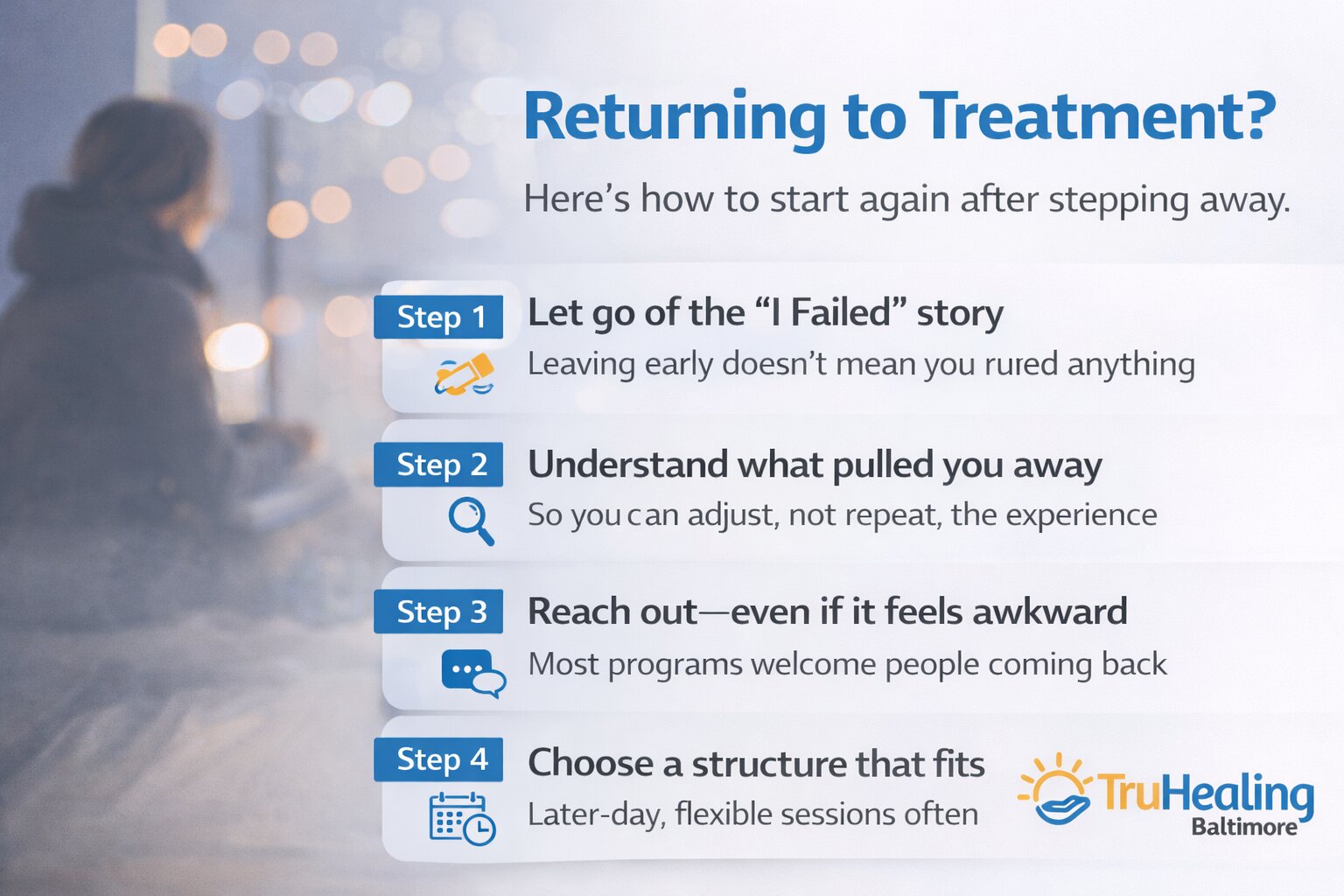
Step 1: Let Go of the “I Failed” Story
Most people who leave treatment early carry a quiet narrative:
I didn’t finish. I messed it up.
But that story isn’t accurate—it’s just loud.
The truth is, stepping away from care usually happens because something didn’t align:
- The schedule didn’t work
- The emotional intensity felt like too much
- Life responsibilities took over
- Or you weren’t ready in that moment
That’s not failure. That’s information.
We’ve worked with many people who came back after leaving—and often, the second experience felt more grounded, more honest, and more sustainable.
You didn’t ruin anything. You paused something that can still continue.
Step 2: Understand What Pulled You Away
Before jumping back in, it helps to get curious—not critical.
Ask yourself:
- What made it hard to keep showing up?
- What felt overwhelming or off?
- What would need to be different for it to feel doable now?
Sometimes people realize:
- They needed more flexibility
- They needed more connection in group
- They weren’t ready to open up yet
- Or their daily life simply couldn’t support the schedule
This step matters because restarting isn’t about repeating the same experience—it’s about adjusting it.
Step 3: Reach Out (Even If It Feels Awkward)
This is the part most people delay.
Not because they don’t want help—but because they don’t know how they’ll be received.
There’s often a thought like:
“They probably think I quit.”
“I don’t want to explain myself.”
Here’s the reality: people return to treatment all the time.
From a facility perspective, your return isn’t inconvenient—it’s welcomed.
You don’t need a speech. You don’t need to justify your absence.
A simple message works:
- “I was in the program before and I’d like to come back.”
- “I’m ready to try again—what would that look like?”
That’s enough to reopen the door.
Step 4: Choose a Structure That Fits Your Life Now
One of the biggest reasons people stop attending is that the structure didn’t match their real-world responsibilities.
Work schedules. School. Family. Energy levels.
This is where flexibility matters.
For many people, options that include later-day sessions or adjusted schedules make consistency more realistic.
That’s why some individuals explore evening outpatient rehab Baltimore options—because it allows them to stay engaged in care without stepping away from everything else in their life.
You don’t need a perfect schedule.
You need one you can actually stick to.
Step 5: Expect a Reset—Not a Resume
Coming back doesn’t mean picking up exactly where you left off.
It’s more like starting with new information about yourself.
Your care team may:
- Reassess your current needs
- Adjust your schedule
- Shift how sessions are structured
- Help you ease back in at a manageable pace
This isn’t about putting you “behind.”
It’s about setting you up to stay.
Step 6: Show Up Messy, Not Perfect
A lot of people leave treatment because they feel like they’re doing it wrong.
They think:
- “I’m not opening up enough.”
- “I’m not improving fast enough.”
- “Everyone else seems further along.”
So they pull away.
But the people who benefit most from coming back aren’t the ones who do it perfectly.
They’re the ones who:
- Show up tired
- Show up unsure
- Show up quiet at first
- And keep showing up anyway
Consistency matters more than confidence.
There’s a difference between being ready and being willing.
You don’t need to feel ready. Just willing is enough.
Step 7: Let the Second Time Be More Honest
There’s something powerful about coming back after stepping away.
You’re not walking in blind anymore.
You know what felt hard.
You know where you held back.
You know what didn’t work for you.
That awareness can shift everything.
We’ve seen clients return and say:
- “I didn’t pretend this time.”
- “I actually said what I was thinking.”
- “I stopped trying to do it perfectly.”
And that’s often where real progress begins.
Not in doing it right—but in doing it real.
Step 8: Give Yourself Permission to Stay This Time
Restarting treatment isn’t just about getting back in.
It’s about giving yourself permission to stay, even when it feels uncomfortable.
There will be days when:
- You don’t want to go
- You question if it’s working
- You feel disconnected
That’s not a sign to leave again.
That’s usually the moment where growth is trying to happen.
A simple mindset shift can help:
Instead of asking, “Is this working yet?”
Try asking, “Can I stay with this a little longer?”
You’re Not the Only One Who’s Done This
It might feel like you’re the only one who left.
You’re not.
Many people who are stable today:
- Missed weeks
- Dropped out early
- Took time away
- Came back unsure
And then slowly, they built something steadier.
Not because they got it right the first time.
But because they came back.
A Way Forward That Fits Real Life
If you’ve been thinking about restarting but haven’t taken the step yet, you don’t need a full plan.
You just need a starting point that feels manageable.
If you’re looking for treatment in Baltimore, TruHealing Maryland offers care options designed to work with your schedule—not against it—so returning feels possible, not overwhelming.
FAQs: Restarting Care After You’ve Stepped Away
Can I really come back after leaving treatment early?
Yes. This happens more often than people think. Programs are built to support people at different stages—including those returning.
Will I have to explain why I stopped?
You can share as much or as little as you want. The focus is on helping you move forward, not analyzing your absence.
Will I have to start over completely?
Not necessarily. Your care team will reassess where you are now and build a plan that fits your current needs.
What if I’m not sure I’m ready again?
You don’t need to feel fully ready. Willingness to try is enough to begin.
What if my schedule made it hard before?
That’s something that can be adjusted. Flexible options, including evening sessions, can help make treatment more realistic.
What if I leave again?
That fear is common. Instead of focusing on “what if,” focus on what you can do differently this time—starting with showing up one day at a time.
You Can Still Come Back to This
If part of you has been thinking about returning, even quietly—that part matters.
You don’t need to wait until everything feels certain.
You don’t need to have the right words.
You just need a moment of willingness.
Call (833) 782-2241 or visit our treatment programs, intensive outpatient program services in Baltimore, Maryland to learn more about our treatment programs, intensive outpatient program services in Baltimore, Maryland.
And just so you hear it clearly:
You didn’t lose your chance. You just paused your path.