

I thought 90 days meant I was solid.
When I left live-in treatment in Baltimore, I felt clear. Strong. Different. I had a routine. I had phone numbers. I had people cheering me on.
I also had pressure building quietly underneath.
On day 91, I relapsed.
If that’s where you are right now — ashamed, confused, scared you ruined everything — I want you to sit with this:
Relapsing after 90 days doesn’t erase what you learned.
But it does reveal what still needs attention.
And that revelation can save your life.
The Confidence That Slowly Turned Into Complacency
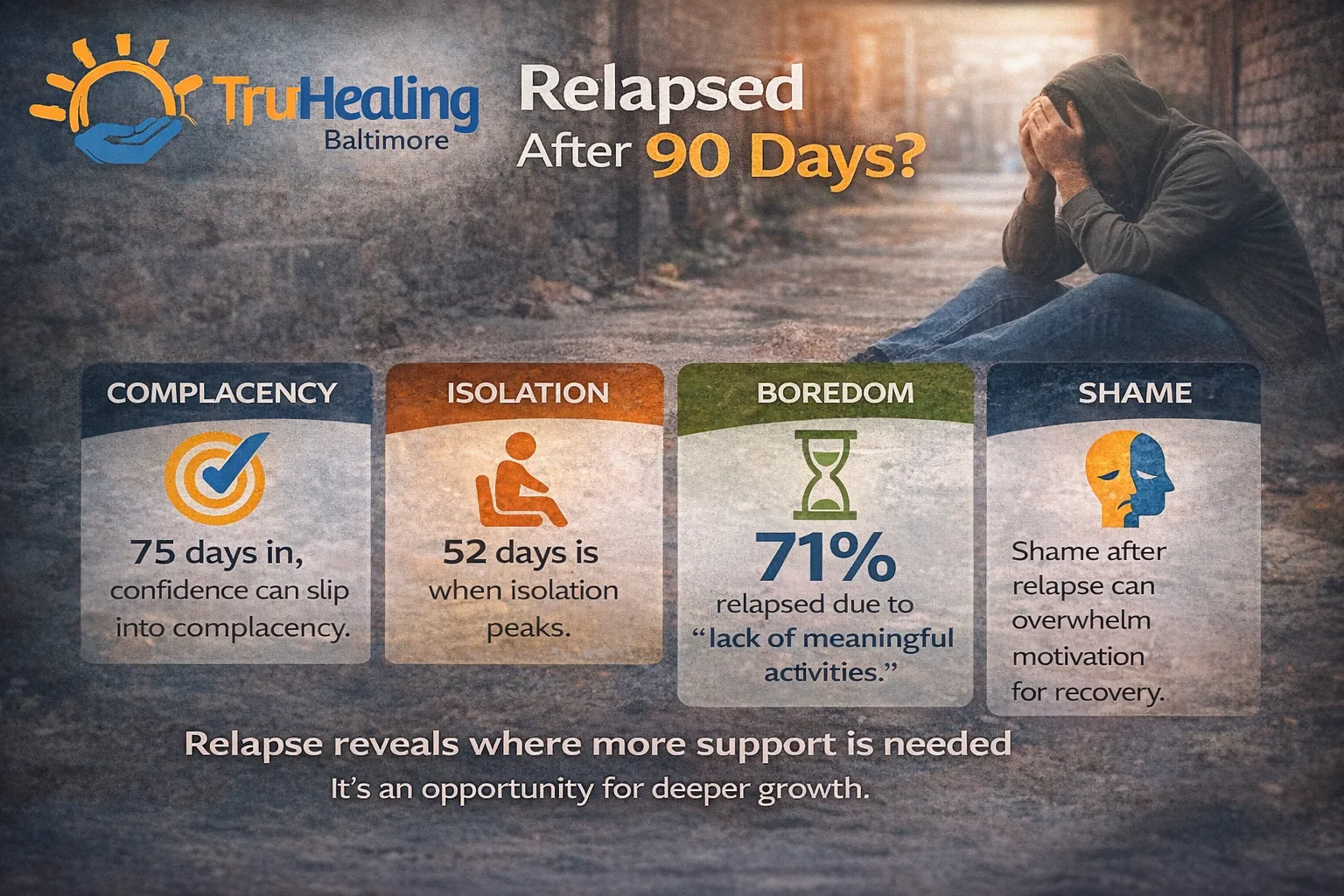
Around 60 days, people started saying, “You look great.”
Around 75 days, they said, “You’ve got this.”
Around 90 days, I believed them.
I wasn’t white-knuckling anymore. The cravings had softened. My body felt stable. The chaos was gone.
But something else was fading too.
Urgency.
In early recovery, everything feels critical. You guard your sobriety like it’s oxygen.
By 90 days, the adrenaline wears off.
And when the urgency fades, you either deepen your recovery — or you drift.
I drifted.
The Relapse Didn’t Start With a Drink
It started with isolation.
Skipping one meeting.
Not returning a call.
Saying “I’m good” when I wasn’t.
Isolation doesn’t feel dramatic.
It feels manageable.
Until it isn’t.
I didn’t relapse because I stopped caring about recovery. I relapsed because I stopped letting anyone see the parts of me that were struggling.
That silence became the crack.
Stability Felt… Boring
No one prepared me for that.
After leaving structured care, life felt quiet.
No crisis.
No chaos.
No intense breakthroughs.
Just work. Groceries. Evenings at home.
And for someone who had lived in emotional extremes, that quiet felt empty.
I mistook boredom for freedom.
And boredom, untreated, can be dangerous.
I didn’t want to get high.
I wanted to feel something.
That distinction matters.
The Shame Was Immediate and Loud
The moment it happened, my mind went to zero.
“You’re back at square one.”
“You wasted everyone’s time.”
“You’re exactly who you were.”
Shame is brutal after a relapse.
But here’s what I didn’t realize in that moment:
The 90 days had already changed me.
I felt the difference immediately.
Before treatment, I could spiral for months.
After those 90 days, the awareness hit fast. I knew something was off. I knew I didn’t want to go back fully.
That awareness was growth.
Even in relapse, growth was present.
A residential treatment program had planted something in me that didn’t disappear with one mistake.
The Hard Truth I Had to Accept
I wasn’t as connected as I thought.
I was performing recovery.
Showing up.
Saying the right things.
Counting the days.
But internally? I was lonely.
I hadn’t fully addressed my anxiety. I minimized my depression. I avoided the deeper emotional work because being “stable” felt good enough.
Recovery at 30 days is survival.
Recovery at 90 days demands depth.
I hadn’t gone deep enough.
Why Going Back Felt Worse Than Going the First Time
The first time, I was desperate.
The second time, I was embarrassed.
Calling for help after relapse felt humiliating. I imagined disappointment. I imagined eye rolls. I imagined being told I should’ve known better.
Instead, I heard something simple:
“Come back in.”
No drama. No lectures.
Just structure.
Returning didn’t erase my relapse.
It interrupted it.
And that interruption made all the difference.
What I Learned About Pride
At 90 days, I thought I needed to prove I could handle life.
I stopped asking for help as quickly.
I stopped admitting when I was struggling.
I started believing I should be further along.
Pride is subtle in recovery.
It sounds like:
“I’ve got this.”
“I don’t need to bother anyone.”
“I don’t want to look weak.”
But recovery doesn’t reward pride.
It rewards honesty.
The second time around, I chose honesty faster.
That choice saved me.
The Myth of “Starting Over”
If you relapsed, you might feel like you’re back at zero.
You’re not.
You’re starting informed.
You now know:
- What your weak spots are.
- What isolation feels like.
- How quickly things can shift.
- What early warning signs look like in your body.
That’s not square one.
That’s data.
And data builds stronger recovery.
The Pressure Around Milestones
There’s something about 30, 60, 90 days.
Expectations grow.
Compliments increase.
Support sometimes decreases because people assume you’re solid.
Milestones can create pressure.
And pressure without continued vulnerability can crack even strong foundations.
If you relapsed around 90 days, you’re not uniquely flawed.
You’re human.
Many of us hit that wall.
Some of us hide it.
Some of us come back.
What Changed the Second Time
The first time, I focused on stopping substances.
The second time, I focused on building a life.
I addressed:
- My untreated anxiety.
- My tendency to isolate.
- My discomfort with boredom.
- My avoidance of vulnerability.
A residential treatment program the second time wasn’t about detox.
It was about depth.
And depth was what I had been avoiding.
That shift mattered.
If You’re an Alumni Reading This in Shame
You might be thinking:
“They trusted me.”
“I let everyone down.”
“I don’t deserve another chance.”
Let me say this clearly:
Relapse does not cancel your courage.
It reveals where you still need support.
And asking for support again is not weakness.
It’s maturity.
If you’re in Baltimore County, Maryland, sitting in your car right now debating whether to call, know that you’re not the only one who has made that call twice.
You won’t be judged.
You’ll be met.
And if you’re in Anne Arundel County, Maryland, wondering whether going back means you failed the first time, understand this: many alumni who return engage more deeply because pride has softened.
That’s not failure.
That’s growth.
FAQs: What Relapsed Alumni Really Want to Know
Did I Ruin My Progress?
No. Neural pathways built over 90 days don’t vanish overnight. Skills don’t disappear. Awareness doesn’t reset to zero. Relapse is a setback, not an erasure.
Does This Mean Treatment Didn’t Work?
No. It may mean you need more time, more depth, or different supports layered in. Treatment isn’t a magic wand. It’s a foundation. Sometimes foundations need reinforcement.
Will People Be Disappointed?
Some may be. But disappointment isn’t devastation. And many will feel relieved you were honest. Silence is far more damaging than relapse.
How Do I Stop the Spiral Now?
Act quickly. Don’t wait for it to get worse. Reach out. Be honest. Interrupt the pattern early. Relapse grows in delay. It shrinks in accountability.
Is Going Back Worth It?
If you don’t want this relapse to become your new normal, yes. Going back doesn’t mean repeating the same script. It means engaging differently. More honestly. More vulnerably. More deeply.
If You’re One Call Away From Either Hiding or Healing
You have two options right now.
Hide and hope it doesn’t get worse.
Or return and rebuild stronger.
You are not the only alumni who has stumbled after 90 days.
And you are not disqualified from recovery because of it.
If you’re considering reconnecting with structured support or returning to a residential treatment program, you don’t have to navigate that decision alone.
Call (833) 782-2241 to learn more about our Residential treatment program in Baltimore, Maryland.