

There’s a specific fear I hear from creative, thoughtful, emotionally intense people.
It’s not, “Will this be hard?”
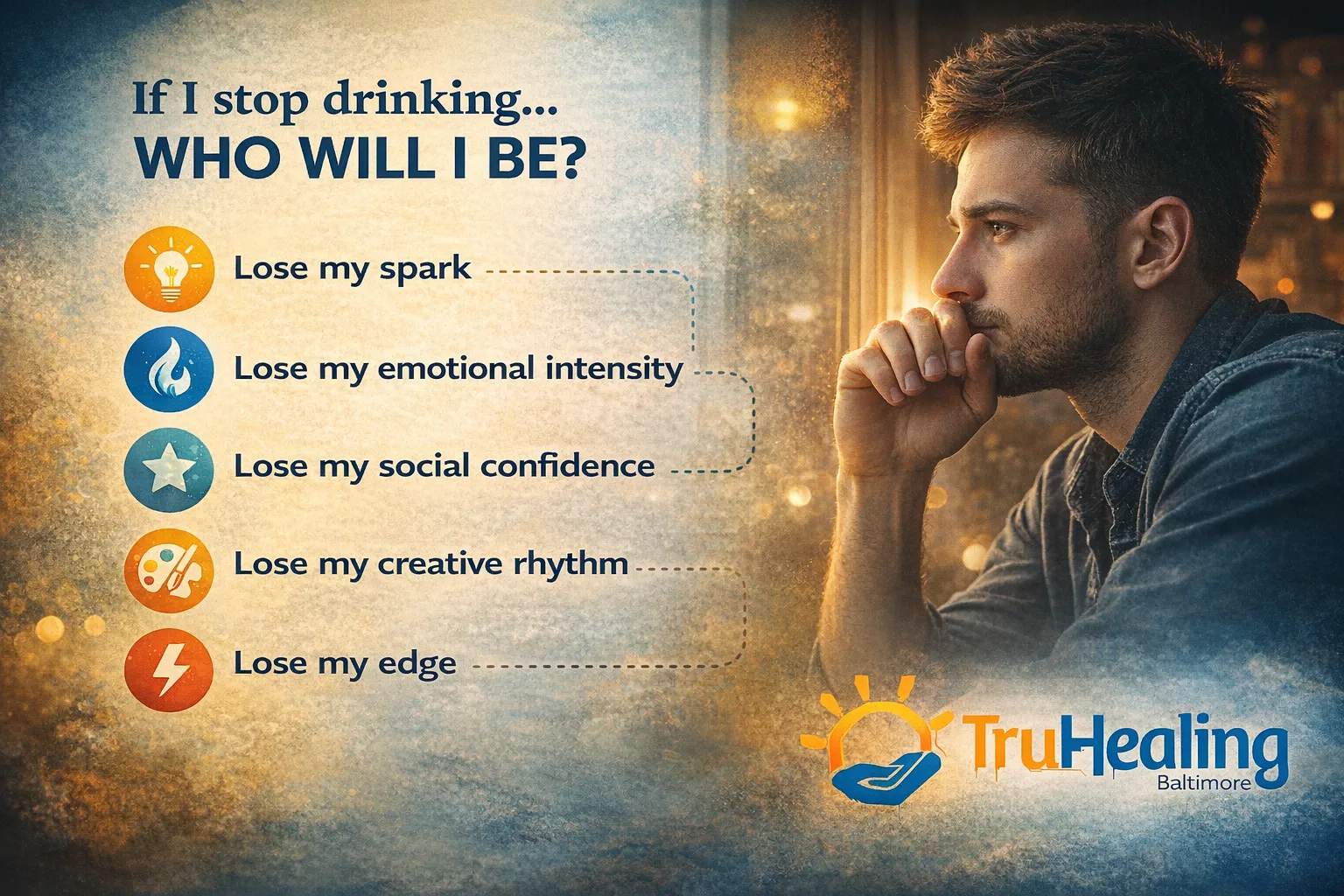
It’s, “If I stop drinking… who will I be?”
If you’ve quietly searched for support for alcohol use, you may not be scared of treatment itself.
You may be scared of losing the person you’ve always known yourself to be.
For many individuals and families in Howard County, Maryland this fear doesn’t sound dramatic on the outside. It sounds like hesitation. It sounds like, “I’m not sure I’m ready.” But underneath that hesitation is something tender:
What if sobriety makes me smaller?
And for those coming from Carroll County, Maryland, the concern often carries a quiet edge: What if the version of me people love only exists when I drink?
As a clinician, I want to meet that fear respectfully. Not dismiss it. Not talk you out of it. Just sit with it for a moment.
Because it makes sense.
The Version of You Alcohol Helped Shape
Maybe alcohol helped you feel:
- More social at gatherings
- Less self-conscious in creative spaces
- More expressive with your emotions
- More spontaneous
- More daring
For some people, drinking isn’t just a habit. It becomes part of their story.
You might be the bold one. The deep thinker. The life of the party. The artist who stays up late chasing inspiration. The friend who always says yes.
Alcohol can feel like a spotlight—bright, warm, and energizing.
So when someone suggests stepping away from it, it can feel like someone is dimming the lights.
Of course that feels threatening.
The Fear Isn’t About Drinking — It’s About Identity
When someone tells me, “I don’t want to get boring,” I don’t laugh.
I don’t correct them.
Because they’re not talking about entertainment value.
They’re talking about losing:
- Their spark
- Their emotional intensity
- Their social confidence
- Their creative rhythm
- Their edge
There’s a cultural myth that sobriety equals blandness. That recovery equals restraint. That clarity equals conformity.
But the truth is more nuanced.
Alcohol doesn’t create your personality. It temporarily exaggerates parts of it—and quietly taxes the rest.
The humor that once felt effortless begins requiring more alcohol to access.
The vulnerability that once felt freeing turns into oversharing you regret.
The late-night creativity becomes late-night anxiety.
You don’t lose yourself all at once.
You erode slowly.
The Quiet Costs You Might Not Notice
Identity-focused drinkers rarely hit a dramatic rock bottom. Instead, the losses accumulate in subtle ways.
You might notice:
- You need a drink to enter social spaces that used to feel natural.
- You promise yourself you’ll create tomorrow, but tomorrow starts with fatigue.
- You feel emotionally intense at night and emotionally drained in the morning.
- You perform confidence instead of feeling grounded.
- You rely on alcohol to “access” parts of yourself that used to be organic.
Over time, what once felt like fuel becomes friction.
It’s not that alcohol stops working entirely.
It just works less.
And costs more.
Sobriety Doesn’t Erase You — It Reveals You
One client once told me, “I thought I’d lose my chaos. I didn’t realize I’d lose my fog.”
That distinction matters.
When people begin Alcohol addiction treatment, they often brace for personality loss. They expect to feel muted or dulled.
Instead, many describe something unexpected.
Clarity.
Not hyper-control. Not emotional flatness. But steadiness.
You still feel deeply.
You still think creatively.
You still connect intensely.
But your nervous system isn’t swinging wildly between extremes.
And when your system stabilizes, your identity often strengthens.
Because it’s no longer chemically amplified. It’s authentic.
The Myth of the “Edgy” Creative
There’s a powerful story in our culture:
Artists must suffer.
Charisma requires recklessness.
Depth comes from destruction.
It’s romantic. It’s compelling.
It’s also incomplete.
In clinical practice, I’ve seen writers finish books after stepping away from alcohol. I’ve seen musicians write more consistently. I’ve seen entrepreneurs lead with clearer thinking.
Not because they became safer or smaller.
But because they became less distracted.
Alcohol often feels like expansion.
In reality, it narrows your range. It dictates when you can feel bold, when you can feel open, when you can relax.
When you remove that dependency, your range widens.
And widened range is creative freedom.
You’re Allowed to Grieve the Idea of It
Here’s something rarely said out loud:
You can miss alcohol and still choose change.
You can feel nostalgic about the early days. The laughter. The looseness. The rituals.
Grief doesn’t mean you’re weak.
It means something mattered.
But grief can coexist with growth.
You’re not betraying your past self by evolving.
You’re protecting your future self.
What Early Recovery Actually Feels Like
In the beginning, there is often quiet.
A space where alcohol used to live.
That quiet can feel uncomfortable at first. Even lonely.
Your nervous system is recalibrating. Your brain is relearning regulation. Your emotions are coming into focus without distortion.
That doesn’t feel glamorous.
It feels real.
And real is steady.
Over time, people often notice:
- Their ideas feel clearer.
- Their conversations feel more meaningful.
- Their confidence feels internal rather than performative.
- Their creativity shows up without needing a trigger.
The shift is subtle.
But it’s profound.
Identity Isn’t That Fragile
If your humor, talent, connection, and emotional depth vanish without alcohol, then they were never truly yours.
But in my experience, that’s not what happens.
Your intensity remains.
Your imagination remains.
Your social warmth remains.
What fades is the volatility.
And volatility isn’t personality.
It’s instability.
When people worry they’ll become “less,” what they often become is more regulated.
More grounded.
More present.
More trustworthy to themselves.
That doesn’t make you boring.
It makes you powerful in a different way.
A Different Kind of Freedom
There is a kind of freedom in drinking.
It lowers inhibition.
It softens anxiety.
It feels spontaneous.
There is another kind of freedom in not needing it.
Freedom to show up clear.
Freedom to leave when you want.
Freedom to remember your own stories.
Freedom to trust your reactions.
The first kind of freedom is loud.
The second kind is durable.
One burns bright and fades fast.
The other glows steady.
You Don’t Have to Decide Forever
If you’re reading this and feeling torn, know this:
You don’t have to commit to a lifetime today.
You don’t even have to label yourself.
You can start with curiosity.
Curiosity sounds like:
- “What would I feel like after 30 days?”
- “What happens if I create without drinking?”
- “Who am I when I’m fully present?”
Curiosity is not surrender.
It’s exploration.
And exploration is something creative people understand deeply.
Frequently Asked Questions
Will I lose my creativity if I stop drinking?
Research and lived experience suggest the opposite is often true. Alcohol may lower inhibition temporarily, but it also disrupts memory, focus, and long-term consistency. Creativity thrives in clarity and sustained energy.
You may create differently at first. But different doesn’t mean diminished.
What if drinking is part of my social identity?
This is common. Social groups often form around shared rituals. In early recovery, you may need to adjust environments. Over time, many people find deeper connections—ones not dependent on intoxication.
Authentic connection is quieter, but stronger.
I’m not sure I’m “bad enough.” Should I still consider help?
You do not need catastrophic consequences to seek support. If alcohol feels tied to your identity in a way that scares you to untangle, that’s worth exploring.
Treatment is not only for crisis. It’s for clarity.
What if I try and feel flat?
Early emotional recalibration can feel unfamiliar. Your nervous system is adjusting. This doesn’t mean your personality is gone. It means your brain is stabilizing. That phase often passes with time and support.
Do I have to give up everything at once?
Not necessarily. Many people begin with structured daytime care or multi-day weekly treatment that allows gradual adjustment. Change can be paced.
This is not about erasing you overnight.
What if I miss the old version of myself?
You might.
And that’s okay.
Missing something doesn’t mean you should return to it. It means it was meaningful. With support, you can honor what alcohol once symbolized without needing to rely on it.
You are not fragile.
Your identity is not built on a substance.
If anything, it may have been waiting for a steadier foundation.
If you want to explore your options gently and without pressure, call 833-782-2241 or visit our Alcohol addiction treatment services to learn more.


