

You stayed sober. You did the work. You rebuilt your life from the inside out.
So why does it feel like you’re standing still?
If you’ve been out of treatment for a year or more and something feels off — not dramatic, not dangerous, just flat — you’re not alone. The hard part after a residential treatment program isn’t always avoiding relapse.
Sometimes it’s learning how to keep growing when the crisis is over.
And nobody talks about that part enough.
The Structure Is Gone — And So Is the Momentum
When you were in treatment, life had edges.
You woke up with purpose. You had groups. You had check-ins. You had structure built around your healing. Every day required engagement. You were forced to look at yourself — sometimes painfully — but it meant movement.
Now?
The alarm goes off. You go to work. You handle responsibilities. You come home. You scroll. You sleep.
You’re stable. Functional. Even successful.
But the intensity that once fueled your growth has faded.
In early recovery, progress is obvious. You measure days. You feel cravings change. You rebuild relationships. You can point to visible wins.
In long-term sobriety, progress gets subtle.
And subtle can feel like stagnant.
“I Thought I’d Feel Free By Now”
There’s a quiet expectation most of us carry.
If I stay sober long enough, I’ll feel different.
Lighter. Clearer. Energized.
And sometimes you do.
But sometimes you just feel… normal.
No chaos. No drama. No disaster.
Just regular life.
And regular life can feel underwhelming when you once lived at emotional extremes.
That doesn’t mean you miss the chaos. It doesn’t mean you want to use. It just means your nervous system was used to intensity.
Calm can feel boring before it feels peaceful.
That adjustment phase? It can last longer than anyone tells you.
The Quiet Drift No One Warns You About
Relapse isn’t always loud.
It doesn’t always begin with cravings or secretive behavior.
Sometimes it begins with shrinking.
You stop sharing honestly in meetings.
You tell people you’re “good” when you’re not.
You cancel therapy because nothing is “wrong.”
You convince yourself you’ve graduated from support.
You don’t feel inspired — but you also don’t feel in danger.
It’s a gray zone.
And gray zones are tricky because they don’t scream for attention.
When people from Baltimore County, Maryland finish treatment and return home, the structure shifts dramatically. Life resumes its pace. The community changes. The expectations increase. It can be hard to recreate the depth of connection you once had daily.
That shift alone can create a subtle emotional drift.
Not a collapse.
Just distance.
Growth After Treatment Looks Different
Early recovery is about stabilization.
Long-term recovery is about expansion.
And expansion is uncomfortable in a different way.
Instead of asking, “How do I stay sober today?”
You start asking, “What kind of life am I actually building?”
That’s a harder question.
It requires identity work. Purpose. Relationship repair. Career clarity. Spiritual or emotional depth.
It’s no longer about crisis management.
It’s about meaning.
And meaning doesn’t appear automatically just because you stopped using.
Sometimes alumni who completed a residential treatment program realize that what helped them survive isn’t enough to help them thrive.
That realization isn’t failure.
It’s evolution.
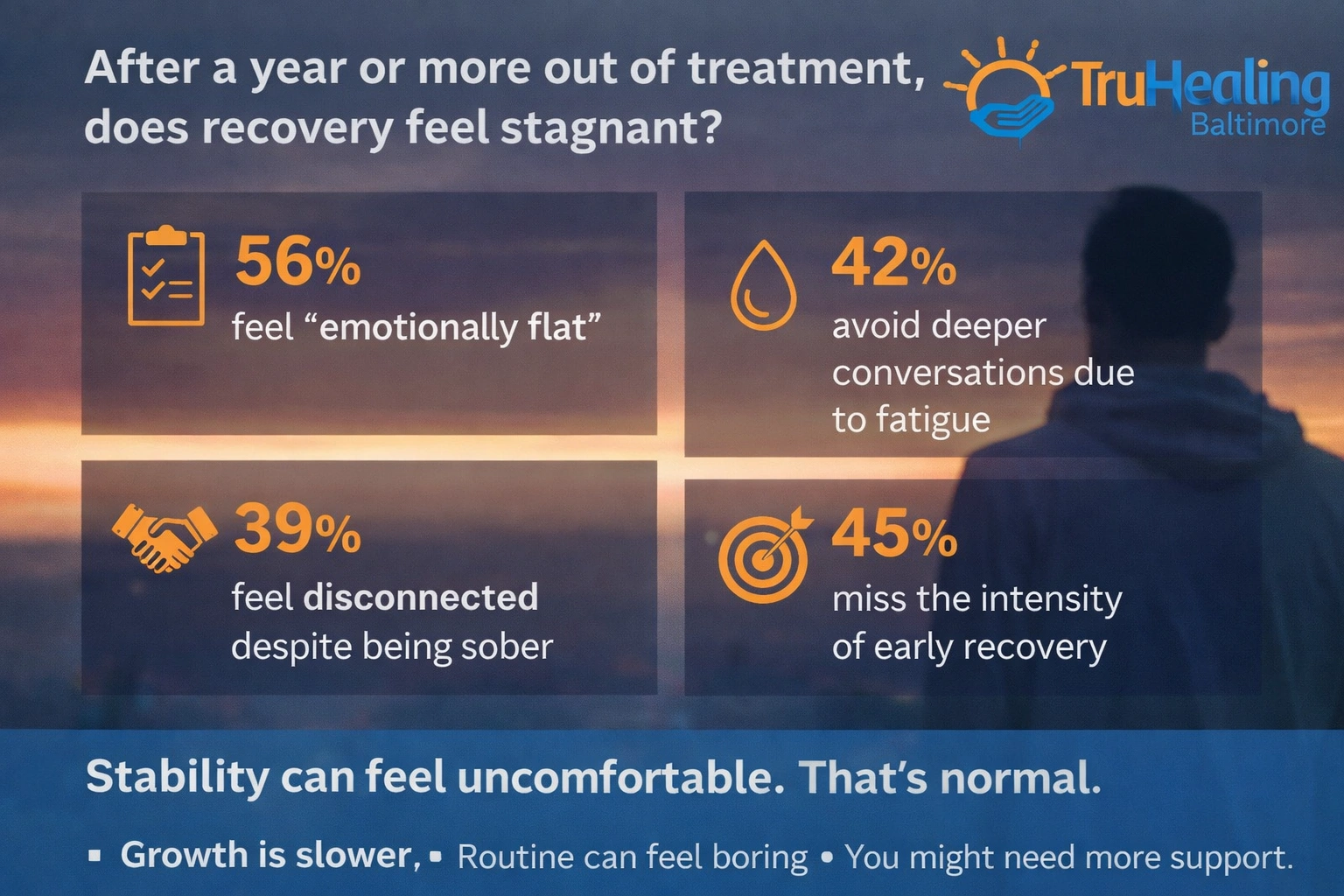
Signs You Might Be Experiencing Stagnation
You might be stuck if:
- You feel emotionally flat but not depressed.
- You’re sober, but disconnected.
- You avoid deeper conversations because they feel exhausting.
- You feel nostalgic for the intensity of early recovery.
- You secretly wonder, “Is this all there is?”
These aren’t relapse red flags.
They’re growth signals.
They mean you’re ready for a new layer.
Why Stability Can Feel Uncomfortable
Addiction often wires us for extremes.
High highs. Low lows. Urgency. Drama. Adrenaline.
When that disappears, the nervous system needs time to recalibrate.
Healthy rhythms can feel unfamiliar.
Predictability can feel dull.
Peace can feel empty before it feels grounding.
And if you’re someone who lives in or around Anne Arundel County, Maryland, you may also be navigating career demands, family roles, community expectations, and the quiet pressure to “have it together” now that you’re sober.
That external stability can mask internal restlessness.
But restlessness isn’t something to suppress.
It’s something to explore.
You Don’t Need a Crisis to Re-Engage
One of the biggest myths in recovery is that you only “go back” if something falls apart.
That’s not true.
Re-engaging with support doesn’t mean you failed.
It can mean:
- You want deeper trauma work.
- You want accountability again.
- You want community that understands long-term recovery.
- You feel numb and want to feel alive again.
- You’re sober — but not fulfilled.
Returning to structured care doesn’t have to be about emergency intervention.
Sometimes it’s about intentional recalibration.
And yes, that can include revisiting elements of a residential treatment program — not because you relapsed, but because you recognize you’re ready to grow in ways that require more support.
That’s strength.
Alumni Stories That Don’t Get Told Enough
You hear relapse stories.
You hear early recovery victories.
You don’t hear enough about the middle years.
Like the alumni who said:
“I didn’t want to use. I just didn’t feel connected to anything anymore.”
Or:
“I had two years sober. A good job. Stable relationship. But inside, I felt like I plateaued.”
Or:
“I realized I was surviving recovery instead of living it.”
These stories aren’t dramatic.
They’re honest.
And they matter.
Because stagnation, left alone, can quietly erode motivation.
Not overnight.
But gradually.
What Reconnection Actually Looks Like
It’s rarely a dramatic reinvention.
It’s usually small, intentional shifts.
- Going back to therapy even when things are “fine.”
- Finding a new recovery community instead of staying comfortable in the old one.
- Exploring creative outlets you avoided.
- Addressing unresolved trauma.
- Setting new goals that scare you a little.
It’s movement.
Even if it’s slow.
Sometimes it also means exploring structured support again — not because you’re in crisis, but because you want accountability and depth.
There is no rule that says treatment is a one-time event.
Recovery evolves.
So should your support.
FAQs: Long-Term Sobriety and Feeling Stuck
Is it normal to feel flat after a year or more sober?
Yes. Emotional flatness is common once the adrenaline of early recovery fades. Your brain and nervous system are adjusting to sustained stability. That adjustment can feel boring before it feels peaceful. Flat doesn’t equal failure. It often means you’re entering a new developmental stage of recovery.
Does feeling stuck mean I’m about to relapse?
Not necessarily. Stagnation is different from craving. However, emotional disconnection can increase vulnerability if ignored. The key isn’t panic — it’s awareness. If you notice isolation, withdrawal from support, or loss of purpose, that’s your cue to re-engage. Not to shame yourself. But to act intentionally.
I completed treatment years ago. Is it weird to consider structured support again?
No. Growth isn’t linear. Many alumni revisit structured environments at different stages — not because they failed, but because they’re pursuing deeper healing. A residential treatment program can serve different purposes at different times in your life. Early on, it may have helped stabilize you. Later, it may offer space for deeper emotional or identity work. Re-entering support isn’t regression. It can be expansion.
What if I’m just bored?
Boredom in recovery often masks something else. Restlessness. Unmet goals. Lack of challenge. Creative suppression. Unprocessed emotion.
Instead of asking, “Why am I bored?” try asking:
- What am I avoiding?
- Where have I stopped growing?
- What scares me that I’m not pursuing?
Boredom can be a doorway.
How do I know if I need more support?
Ask yourself:
- Am I shrinking or expanding?
- Am I honest with at least one person about how I feel?
- Do I feel purposeful — or just functional?
- Am I living intentionally, or coasting?
If you’re coasting and unhappy about it, more support could help.
Not because you’re failing.
But because you want more.
The Truth About Long-Term Recovery
The first year is about survival.
The second year is about stabilization.
After that, it becomes about identity.
Who are you now?
What matters to you?
What do you want your life to feel like — not just look like?
Sobriety isn’t the finish line.
It’s the foundation.
And foundations are meant to hold something bigger.
If you feel stuck, it might not be a warning sign.
It might be an invitation.
An invitation to deepen. To reconnect. To challenge yourself again.
You don’t need to wait for everything to unravel.
You don’t need to justify wanting more.
You’re allowed to outgrow maintenance mode.
You’re allowed to seek structure again — not because you’re weak, but because you’re serious about living fully.
If that resonates, you don’t have to navigate it alone.
Call (833) 782-2241 to learn more about our Residential treatment program in Baltimore, Maryland.


