

They sit down across from me and say some version of the same thing.
“I don’t think I belong here.”
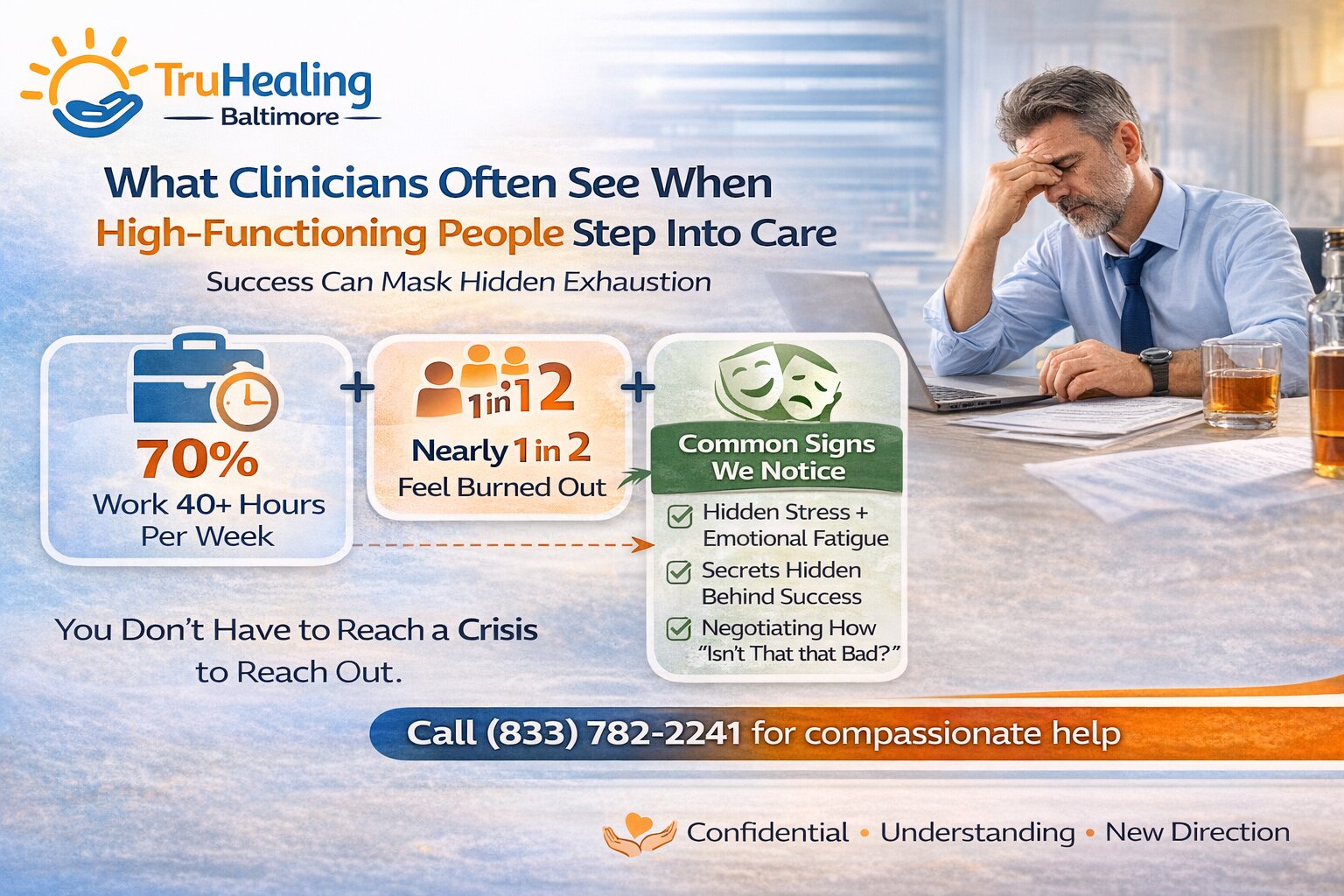
They’re still working. Their career is intact. Their family may not know the full story. On paper, their life still looks successful.
And that’s exactly why many high-functioning people feel uneasy walking into care.
But in places like structured daytime care, we see a pattern again and again. People who appear to have everything together often arrive carrying a kind of exhaustion that doesn’t show up on resumes.
Not chaos.
Pressure.
And clinicians tend to notice it almost immediately.
The First Thing We See Is the Exhaustion
High-functioning clients rarely look disorganized.
They arrive prepared. Thoughtful. Articulate.
Some even apologize for “taking up space” because they believe others need help more than they do.
But behind that competence is often a deep fatigue.
Not just physical tiredness.
It’s the exhaustion of performing stability while privately struggling.
The pressure to keep everything together can become a full-time job.
Work responsibilities. Parenting. Social expectations. Professional reputation.
And then the private coping habits layered quietly underneath it all.
When someone carries that much weight long enough, it shows up in subtle ways.
Tight shoulders. A flat laugh. A long pause before answering honest questions.
Clinicians notice those signals quickly.
Because they’re common among people who have been holding things together for far too long.
The Language of Minimizing
Another pattern shows up early in conversation.
High-functioning clients tend to minimize their own struggle.
You’ll hear things like:
“I mean, I’m not drinking in the morning.”
“I’ve never missed work because of it.”
“I still take care of my responsibilities.”
These statements usually aren’t defensive.
They’re protective.
High achievers are used to solving problems on their own. They’re used to pushing through discomfort.
So when substances become part of the picture, many people shift into negotiation mode instead of recognition.
They start measuring their situation against the worst-case scenarios they’ve seen.
And as long as their life still looks functional, they assume things must be manageable.
But functionality and well-being are not the same thing.
Someone can perform well professionally while quietly struggling emotionally.
Clinicians see that distinction clearly.
The Double Life That Became Normal
High-functioning addiction often involves a kind of quiet dual identity.
There’s the version of you that the world sees.
The competent employee. The responsible parent. The dependable friend.
And then there’s the private version navigating stress, anxiety, burnout, and the substances used to cope with them.
Many people learn how to manage both sides extremely well.
They schedule their drinking around responsibilities. They hide evidence. They tell themselves they’re still in control.
Eventually, the double life stops feeling unusual.
It becomes routine.
But maintaining two separate realities takes enormous emotional energy.
Over time, that energy drain becomes impossible to ignore.
And when high-functioning clients enter care, the relief of not having to manage that split identity anymore can be profound.
The Moment the Mask Slips
There’s a moment that often happens early in care.
It’s subtle.
Someone begins speaking in the same polished tone they use in professional environments. Everything sounds controlled and measured.
Then something shifts.
Maybe it’s a question that lands differently.
Maybe it’s hearing someone else describe a similar experience.
Maybe it’s the realization that no one in the room is judging them.
And suddenly the tone changes.
The professional mask softens.
A sentence comes out that sounds more honest than anything said earlier.
“I didn’t realize how tired I was.”
When that moment happens, clinicians pay attention.
Because it often signals the beginning of real work.
The Fear That Recovery Will Change Who They Are
Many high-functioning individuals worry about losing their identity if they stop using substances.
They fear losing their edge.
Their creativity.
Their confidence in social settings.
Their ability to handle pressure.
These fears are understandable.
Substances often become tied to performance and stress management over time.
But what clinicians frequently observe is something different.
When the underlying issues are addressed — burnout, anxiety, emotional pressure — people often rediscover strengths they thought were dependent on substances.
Their focus improves.
Their decision-making sharpens.
Their relationships deepen.
Instead of losing their identity, many people regain parts of themselves that had been buried under years of coping.
The Relief of Being Honest
For high-functioning clients, one of the most powerful moments in early recovery is surprisingly simple.
They tell the truth.
Not a polished version. Not a minimized version.
Just the truth.
And the room doesn’t collapse.
Their career isn’t instantly destroyed. Their identity doesn’t shatter.
Instead, something else happens.
The tension drops.
Shoulders relax.
For the first time in a long time, they aren’t managing an image.
They’re simply being human.
That shift alone can feel like breathing fresh air after years of holding your breath.
The Quiet Strength We Often See
There’s a misconception that people seeking help are weak or broken.
But clinicians often see something very different.
High-functioning individuals who step into recovery demonstrate enormous courage.
They’re not waiting for life to collapse.
They’re recognizing that the current path isn’t sustainable and choosing to change direction before deeper damage occurs.
That decision requires honesty.
And honesty is rarely easy for people who are used to carrying responsibility for everyone else.
But it’s one of the most powerful steps someone can take.
What Many High-Functioning Clients Realize Later
Weeks into care, many high-functioning clients reflect on the same realization.
They spent years trying to manage everything alone.
The career pressure.
The family expectations.
The private coping habits that slowly became harder to control.
They believed asking for help would mean losing control of their life.
But often the opposite happens.
Support restores stability.
Clarity returns.
Energy that once went into hiding and managing habits becomes available again for work, relationships, and personal growth.
Recovery doesn’t erase success.
It often strengthens it.
Frequently Asked Questions
Can someone be successful and still struggle with addiction?
Yes. Many people maintain careers, relationships, and responsibilities while privately struggling with substance use. High-functioning addiction often goes unnoticed for years because outward stability can mask internal stress.
Why do high-functioning people delay seeking help?
High achievers are used to solving problems independently. They may minimize their struggles or compare themselves to more severe cases, which makes it harder to recognize when support could help.
What do clinicians look for when evaluating high-functioning clients?
Clinicians often look beyond external success and focus on emotional stress, coping habits, and how substances are affecting daily life. Signs like exhaustion, secrecy, and difficulty cutting back can indicate deeper challenges.
Will seeking help affect my professional life?
Many professionals pursue recovery while maintaining their careers. Treatment providers prioritize confidentiality, and many clients continue working while receiving support.
What if my life still seems under control?
You don’t have to reach a crisis point to seek help. Many people begin recovery simply because they recognize their habits are becoming unsustainable or emotionally draining.
How do I know if I should talk to someone?
If substance use is creating stress, secrecy, or emotional exhaustion, it may be worth having a conversation with a professional. Exploring your options doesn’t commit you to anything — it simply provides clarity.
If you’re recognizing yourself in any part of this, support is available.
Call (833) 782-2241 or explore our treatment programs and structured daytime care to learn more about our treatment programs and partial hospitalization program services.
You don’t have to wait for things to fall apart before you decide something needs to change.
And sometimes, the strongest step a high-functioning person can take is simply admitting they don’t have to carry everything alone.