I used to say it like it was a fact: “Treatment just doesn’t work for me.”
Not in a dramatic way. Just… settled. Final.
I had already tried. Showed up. Sat through sessions. Said what I thought I was supposed to say. And still walked away feeling unchanged.
So I stopped believing in it.
If you’re here, there’s a chance you’ve said something similar. Maybe out loud. Maybe just to yourself.
And maybe a small part of you is wondering if trying again would feel exactly the same.
I Didn’t Walk Away All at Once—It Faded Out
There wasn’t a big moment where I decided I was done.
It was quieter than that.
I started checking the clock more than I was listening. I nodded along without really connecting. I told people I was “fine” when I wasn’t even close.
Then I missed a day.
Then another.
Eventually, it felt easier not to go back than to explain why I stopped.
So I told myself the simplest version of the story: “It didn’t work.”
But that wasn’t the full truth.
I Was Showing Up Physically, But Not Really There
This is the part I didn’t want to admit.
I expected something external to change me.
I thought if the structure was strong enough, if the clinicians were good enough, something would just click.
But I stayed guarded.
I filtered what I shared.
I avoided the parts that actually mattered.
I kept one foot out the door the entire time—just in case I decided it wasn’t for me.
And then, when it didn’t fully work, I used that as proof that it never would.
The Next Time Didn’t Feel Magical—It Felt More Honest
Coming back wasn’t inspiring.
There was no “this time will be different” moment.
If anything, I felt skeptical walking in.
But something shifted—not in the program, but in how I showed up.
I stopped trying to perform.
Instead, I said things like:
- “I don’t think this is helping me yet.”
- “Part of me doesn’t want to be here.”
- “I’m still holding onto the same patterns.”
That honesty felt uncomfortable.
But it also felt real.
And real, it turns out, is where things actually start to move.
Structure Did What Motivation Never Could
I used to wait until I felt ready.
That never worked.
What helped wasn’t motivation—it was consistency I didn’t have to negotiate with.
Showing up at the same time each day. Having somewhere to be. Being around people who were also trying, even if imperfectly.
It wasn’t exciting.
But it was steady.
And steady started to feel safe in a way I hadn’t expected.
Some people easing back into care in Howard County, Maryland talk about this shift—that the routine itself starts doing part of the work, even on days when you don’t feel like engaging.
I Stopped Looking for a Breakthrough
I thought change would feel obvious.
Like a switch flipping.
Like one big moment where everything suddenly made sense.
That never happened.
Instead, it looked like:
- Staying in the room when I wanted to leave
- Saying one honest thing instead of ten safe ones
- Noticing my patterns instead of denying them
At first, it felt like nothing.
But over time, those small moments added up to something that actually stuck.
Recovery didn’t feel like a breakthrough.
It felt like learning how to stay, even when it was uncomfortable.
The Difference Wasn’t the Program—It Was My Willingness to Be Seen
This part is hard to say, but it matters.
The first time, I wanted help—but only on my terms.
I wanted to keep control. Keep certain things hidden. Keep parts of myself untouched.
The second time, I was still unsure—but I was a little more open.
Not completely.
Just enough.
Enough to admit when I didn’t believe in the process.
Enough to say when I felt disconnected.
Enough to stop pretending I was further along than I actually was.
That small shift changed everything.
What I Wish I Understood Earlier
I thought treatment either worked or it didn’t.
Like a switch.
Now I see it differently.
It works in layers.
Sometimes the first attempt shows you what you’re not ready for yet.
Sometimes it exposes patterns you didn’t know you had.
Sometimes it plants something that doesn’t fully grow until later.
If I could go back, I wouldn’t tell myself to try harder.
I’d tell myself to be more honest, sooner.
You’re Not the Only One Who Thinks This Way
There are more people than you think who sit with the same belief:
“I already tried. It didn’t help.”
And a lot of them stay stuck there—not because they can’t change, but because they don’t want to feel that disappointment again.
That makes sense.
But what often gets missed is this:
Trying again doesn’t mean repeating the same experience.
It means bringing a different version of yourself into it.
Even if that difference is small.
Some individuals reconnecting with care in Carroll County, Maryland describe it as less about “believing” this time and more about simply being willing to show up a little differently.
You Don’t Have to Be Fully Bought In
This might be the most important part.
You don’t need to believe in treatment for it to help.
You don’t need to feel hopeful.
You don’t need to be confident it will work.
You just need to be a little more honest than you were before.
That’s it.
That’s the starting point.
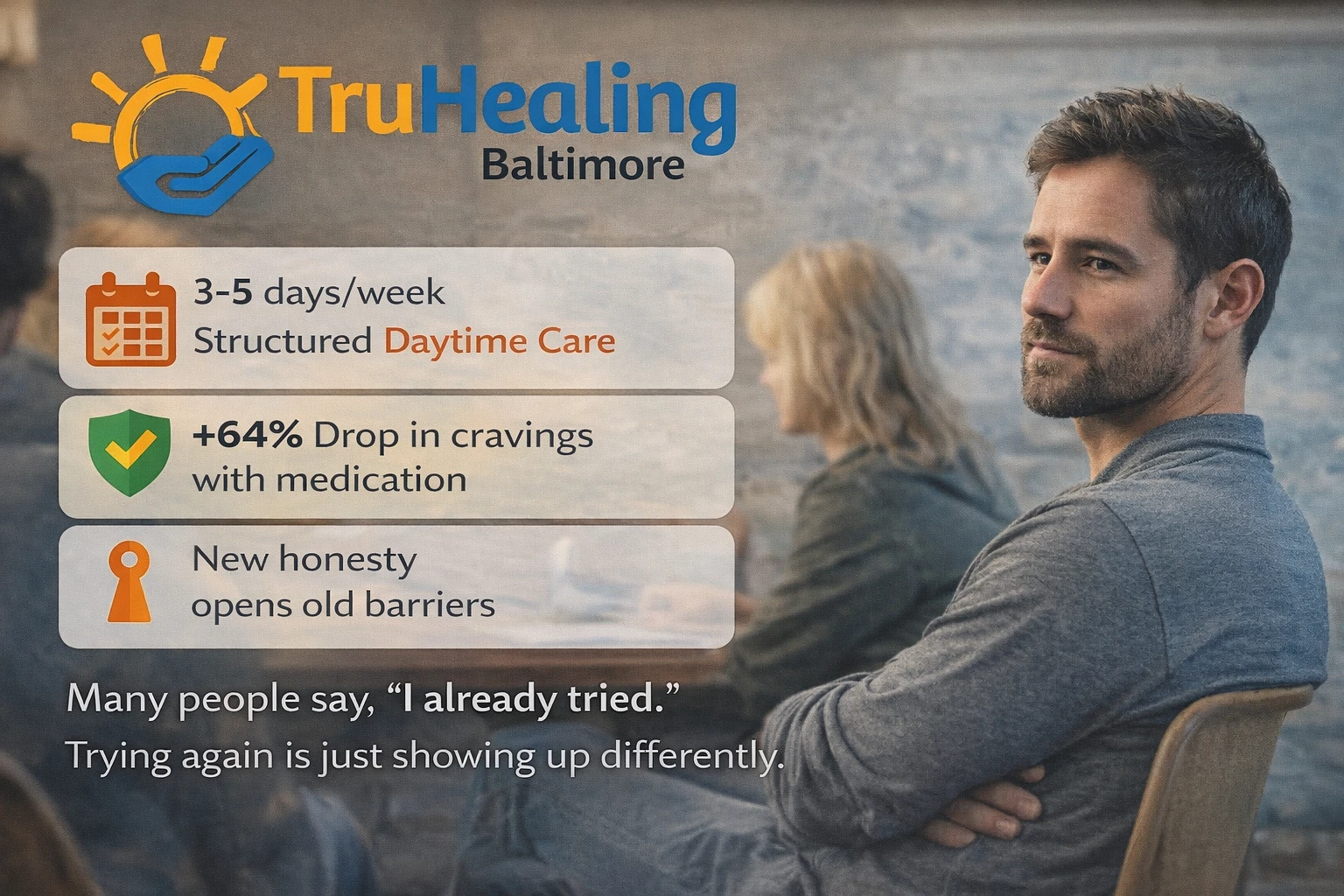
If you’re considering giving it another chance, options like structured daytime care are designed to meet you where you are—even if part of you still doubts it.
What Changed for Me Over Time
It wasn’t fast.
It wasn’t dramatic.
But over time, I noticed things shifting:
- I stopped avoiding difficult conversations
- I became more aware of my own patterns
- I felt less reactive, even in stressful moments
None of that happened overnight.
But it also didn’t happen the first time I tried.
It happened when I came back differently.
If You’re Still Skeptical, Stay Skeptical—Just Stay Open
You don’t have to force yourself into optimism.
You don’t have to pretend this time will be perfect.
Skepticism doesn’t disqualify you.
In some ways, it can make your return more honest.
The goal isn’t to convince yourself everything will work.
It’s to stay open long enough to see if something can shift.
FAQs About Trying Treatment Again After It Didn’t Feel Like It Worked
Is it normal to feel like treatment didn’t work the first time?
Yes. Many people leave feeling disconnected or unsure. That doesn’t mean it failed—it may mean the timing, readiness, or engagement wasn’t aligned yet.
What makes the second attempt different?
Often, it’s not the program—it’s how you show up. Even small increases in honesty or openness can create a very different experience.
What if I still don’t believe it will work?
That’s okay. You don’t need full belief to start. You just need a willingness to show up and be real about where you are.
How do I avoid repeating the same experience?
Focus less on doing things “right” and more on being honest. Say what’s actually true for you—even if it feels uncomfortable.
What if I leave again?
That’s a possibility—and it doesn’t erase progress. Many people build change through multiple attempts, not just one.
Do I have to fully commit for it to help?
No. You can start where you are. Full commitment often develops over time, not at the beginning.
How do I deal with feeling disconnected in sessions?
Say it out loud. Disconnection is something that can be worked through—but only if it’s acknowledged.
You didn’t fail.
You showed up in a way that made sense at the time.
And now, you have the chance to show up a little differently.
That’s where things start to change.
If you want to take that step—even cautiously—support is still here.
Call (833) 782-2241 or visit our partial hospitalization program in Baltimore, Maryland to learn more.