

You let yourself breathe for a second.
They were getting help. They seemed clearer. Maybe even hopeful.
And now you’re watching things slip again—and it makes no sense.
If you’re a parent standing in that confusion, I want you to hear this first: this moment is more common than people admit, and it does not mean your child is beyond help.
Early on, many families begin searching for options like structured daytime care after discharge without realizing how essential that “in-between” level of care can be—not just for stability, but for real, lasting progress.
Let’s slow this down together.
The Part of Recovery That Feels Like a Step Back
There’s a quiet phase in recovery that feels like everything is undoing itself.
Clinically, we don’t see it as failure.
Emotionally, it feels like it.
Your child leaves a structured setting—whether that was a hospital or another intensive level of care—and suddenly the world opens back up.
But they’re not fully ready for it yet.
That gap creates friction:
- More decisions to make
- More emotions to manage
- Less immediate support
And what often happens in that space is not regression—it’s exposure to real-life stress without enough support to handle it yet.
Imagine learning to swim in a supervised pool… and then being dropped into open water too quickly.
Even if they can swim, the environment changes everything.
“They Were Doing So Well”—Why It Changes So Fast
This is one of the most painful parts for parents.
You saw progress. You didn’t imagine it.
But progress inside treatment happens in a controlled environment:
- Consistent routines
- Daily therapeutic support
- Reduced external stress
- Built-in accountability
When your child comes home, those supports disappear almost overnight.
Suddenly they’re expected to:
- Manage their own schedule
- Regulate emotions independently
- Navigate social and environmental triggers
- Possibly return to school or work
That’s a lot—even for someone without mental health challenges.
So when things shift quickly, it’s not because treatment “didn’t stick.”
It’s because they’re trying to use new skills in a much harder environment.
The Hidden Pressure to Be “Okay Now”
Many young adults leave treatment carrying a quiet expectation:
I should be better by now.
They might not say it. But it shapes everything.
And when symptoms return—even slightly—it can feel like proof that something is wrong with them.
That internal pressure often leads to:
- Shame
- Avoidance
- Emotional shutdown
And from the outside, it can look like they’re pulling away or “slipping back.”
But underneath, it’s often fear.
Fear of disappointing you.
Fear of failing again.
Fear that maybe this won’t work at all.
This is where parents often feel helpless—and sometimes guilty.
But this isn’t about something you did wrong.
It’s about a recovery process that needs more time and structure than most people expect.
Why the Middle Level of Care Matters More Than You Think
There’s a reason clinicians recommend step-down care after hospitalization.
Healing doesn’t happen in one setting.
It happens across levels of support that gradually shift responsibility back to the individual.
Think of it like physical healing:
You wouldn’t remove a cast and immediately run a marathon.
You’d rebuild strength slowly, with guidance.
That’s exactly what structured daytime care does.
It provides:
- Ongoing therapy multiple days a week
- Psychiatric support and monitoring
- Skill-building in real-time
- A safe place to process setbacks
All while your child begins re-engaging with daily life.
This is where support after psychiatric hospitalization becomes essential—not optional.
It fills the gap between “safe but controlled” and “independent but overwhelmed.”
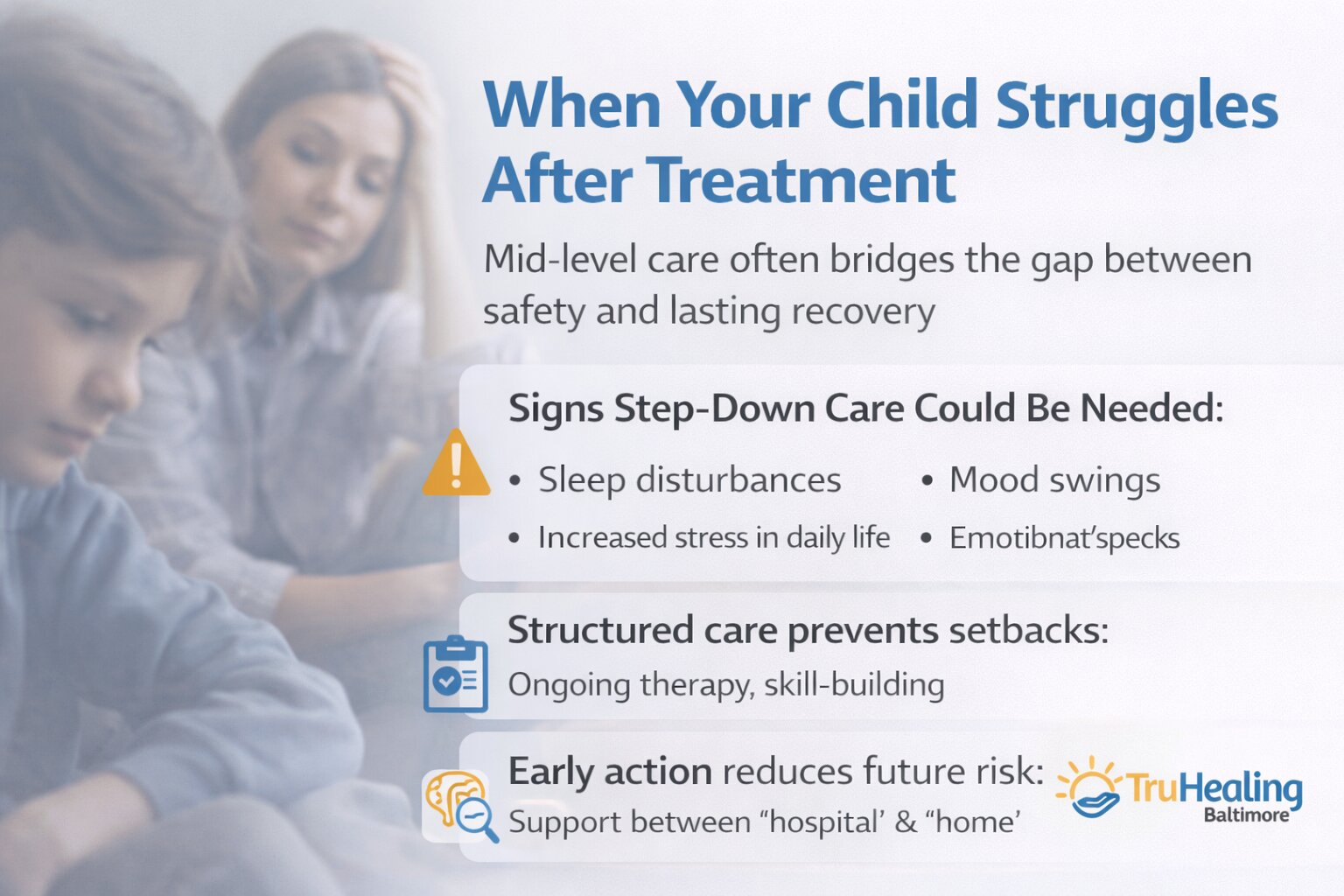
Signs They Might Need More Support (Not Less)
It’s incredibly hard to know what’s normal adjustment versus a sign that more help is needed.
Here are some signals that additional structure could make a difference:
- Sleep patterns becoming irregular again
- Pulling away from family or friends
- Increased irritability or emotional swings
- Loss of motivation or daily functioning
- Avoidance of responsibilities or commitments
- Re-engaging in unhealthy coping patterns
These signs don’t mean your child is failing.
They mean their current level of support may not match what they’re facing.
And that’s something we can adjust.
What Parents Often Try—and Why It Doesn’t Always Work
In this phase, parents are often navigating without a clear map.
Out of love, you might:
- Give more independence, hoping it builds confidence
- Step in more, hoping to prevent things from getting worse
- Avoid conflict to keep peace in the home
Every one of these responses makes sense.
But recovery usually doesn’t respond well to extremes.
Too much independence too soon can feel overwhelming.
Too much control can feel suffocating.
What actually helps is something more balanced:
Consistent, structured support that doesn’t rely solely on you.
Because you’re not meant to carry this alone.
The Emotional Whiplash Parents Don’t Talk About
There’s something else happening here—something quieter.
You’re grieving.
Not just the setbacks, but the uncertainty.
The version of your child you glimpsed during treatment…
and the fear of losing that again.
That emotional back-and-forth—hope, relief, fear, confusion—can be exhausting.
Many parents think they need to be stronger or more certain.
But the truth is, this is one of the hardest places to stand.
You’re allowed to feel all of it.
You Didn’t Imagine Their Progress—and This Doesn’t Erase It
Let’s come back to something important.
What you saw before was real.
Their effort was real.
Their growth was real.
Their moments of clarity were real.
This current struggle doesn’t undo that.
Recovery isn’t linear. It’s layered.
Sometimes what looks like a step back is actually the moment where deeper support becomes visible.
A metaphor I often share with families:
Recovery isn’t like climbing a staircase. It’s more like learning to walk on uneven ground.
There will be missteps. That doesn’t mean they’ve forgotten how to walk.
A Gentle Next Step for You (and Them)
If you’re feeling stuck—caught between concern and uncertainty—you don’t have to solve everything at once.
But this might be the moment to explore options that provide structure without returning to full hospitalization.
Programs that offer consistent, daytime care can help your child:
- Stay connected to treatment
- Practice real-life coping skills
- Stabilize emotionally
- Rebuild confidence at a manageable pace
If you’re looking for guidance, you can explore treatment options in Baltimore through TruHealing Maryland and see what level of care fits where your child is right now.
FAQs: What Parents Often Ask in This Phase
Is it normal for symptoms to come back after treatment?
Yes. It’s more common than people expect. Treatment provides stability, but real-life environments can reintroduce stress that requires ongoing support.
Does this mean treatment didn’t work?
No. It often means treatment was incomplete, not ineffective. Many people need step-down care to maintain and build on progress.
How do I know if they need more structured care again?
Look at functioning, not just words. Changes in sleep, mood, behavior, and engagement are often clearer indicators than what they say.
Should I push them to go back to treatment?
Gentle encouragement is more effective than pressure. Framing it as continued support, not failure, can make a big difference.
Am I doing something wrong as a parent?
No. You’re responding to a complex situation with limited guidance. The goal isn’t perfection—it’s finding the right level of support for both of you.
What if they refuse help?
This is one of the hardest realities. Even then, you can seek guidance, set boundaries, and stay connected without enabling harmful patterns.
You’re Not Alone in This
If this moment feels confusing, heavy, or even discouraging—you’re not the only parent standing here.
And more importantly, this is not the end of your child’s story.
Sometimes, it’s the point where the right kind of help becomes clearer.
Call (833) 782-2241 or visit our treatment programs, partial hospitalization program services in Baltimore, Maryland to learn more about our treatment programs, partial hospitalization program services in Baltimore, Maryland.