

You don’t have a dramatic story.
You’re still showing up to work. You’re paying your bills. You’re keeping most promises.
And yet… something keeps nudging you.
If you’ve been quietly asking whether something more structured — like live-in treatment in Baltimore — might make sense for you, this isn’t about labeling you.
It’s about helping you think clearly.
No pressure. No assumptions. Just honesty.
Step 1: Separate “Not Rock Bottom” From “Actually Okay”
One of the biggest myths in recovery is that you have to crash hard before you qualify for real help.
That’s simply not true.
Ask yourself:
- Am I proud of how I’m coping?
- Do I feel aligned with my values?
- Am I living intentionally — or reacting constantly?
You don’t need a DUI, job loss, or public fallout to justify stepping away.
Sometimes the real warning sign isn’t disaster.
It’s quiet dissatisfaction.
If you’re functioning but internally negotiating every week — “I’ll cut back next month,” “I’ll only drink on weekends,” “I’ll manage it better this time” — that negotiation is data.
Data deserves attention.
Step 2: Measure the Mental Load, Not Just the Behavior
A lot of sober curious people focus only on quantity.
How much am I using?
How often?
But here’s a better question:
How much mental space is this taking up?
Are you:
- Thinking about it during the workday?
- Planning your week around it?
- Replaying what you said or did afterward?
- Promising yourself limits you don’t keep?
You can look stable from the outside and still feel mentally crowded inside.
If substances occupy more brain space than you’d like, that matters.
A residential treatment program isn’t just about stopping behavior.
It’s about quieting the constant negotiation in your head.
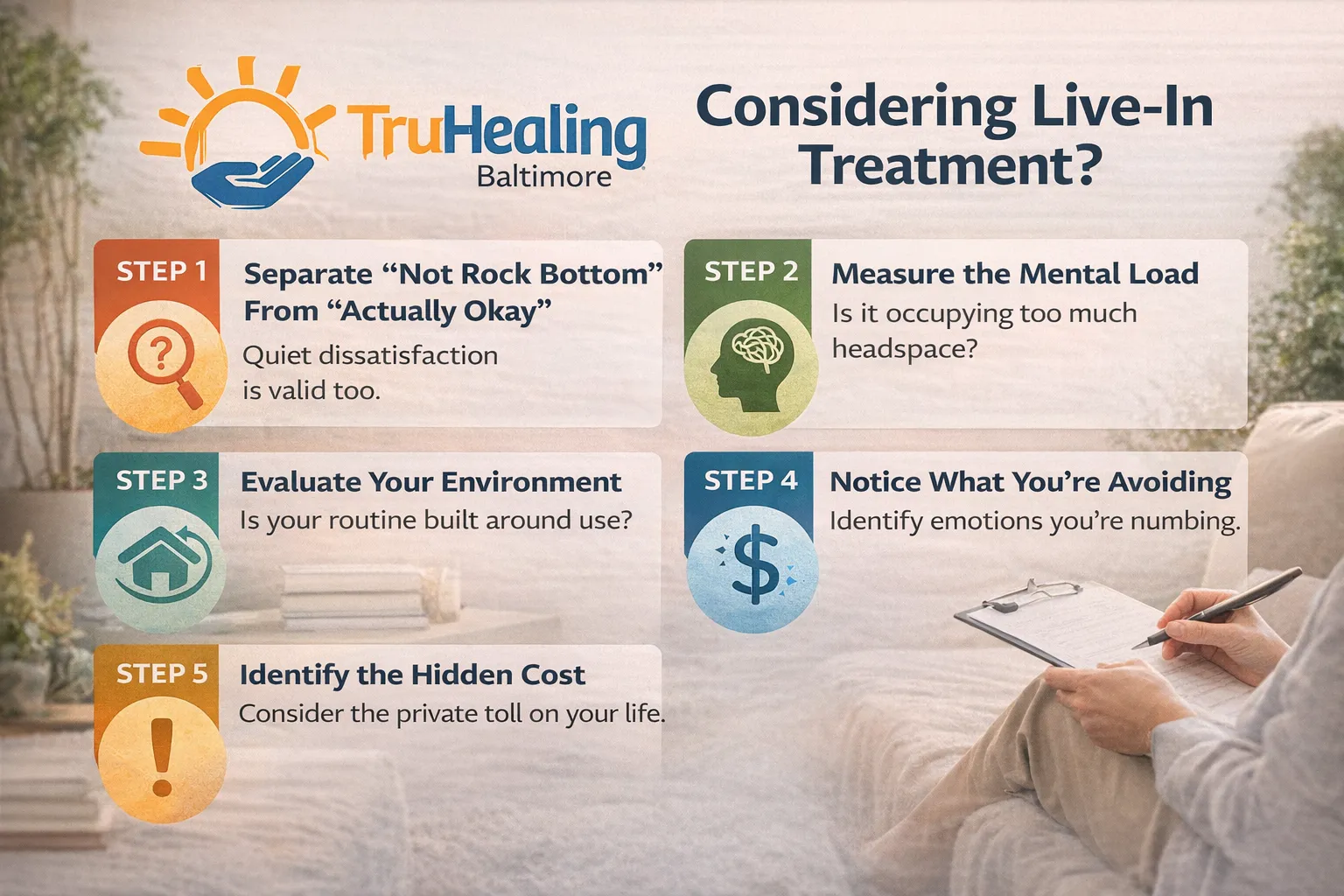
Step 3: Evaluate Your Environment Honestly
Some people can change habits while staying in the same environment.
Others can’t.
Be brutally kind with yourself here.
Are your routines built around drinking or using?
Do your friendships revolve around it?
Does stress at home push you toward the same coping tools every time?
If you live in Baltimore County, Maryland, you already know how easy it is to stay in familiar patterns. Same restaurants. Same social circles. Same expectations.
Environment reinforces behavior.
Stepping away doesn’t mean you’re weak.
It means you understand context matters.
Step 4: Notice What You’re Avoiding
Here’s a harder question:
What would you have to face if you stopped?
Loneliness?
Anxiety?
Unresolved grief?
Relationship dissatisfaction?
Sometimes substances aren’t the primary problem.
They’re the buffer.
If you suspect there’s something underneath that you haven’t fully dealt with, round-the-clock support can provide the space to unpack it safely.
You don’t have to know exactly what it is.
You just have to admit it might be there.
Step 5: Identify the Cost — Not Just the Consequences
High-functioning doesn’t mean cost-free.
The cost may show up as:
- Low-grade shame.
- Fatigue.
- Irritability.
- Disconnection from people you love.
- Feeling slightly off-center all the time.
If you’re in Anne Arundel County, Maryland, juggling work, family, social expectations, and private coping habits, you might be carrying more than you admit.
Cost accumulates quietly.
A residential treatment program interrupts that accumulation before it becomes collapse.
It’s not about punishing you for consequences.
It’s about preventing deeper ones.
Step 6: Clarify Whether You Want Relief — Or Real Change
Relief says:
“I just need a break.”
Change says:
“I’m willing to rebuild how I handle stress, emotion, and discomfort.”
Relief cycles.
Change restructures.
If you only want relief, you can probably white-knuckle your way through another month.
If you want change, you’ll likely need support that goes beyond willpower.
Live-in treatment removes daily distractions long enough for you to build new patterns without constant interruption.
That kind of focused reset is difficult to create in the middle of regular life.
Step 7: Listen to the Part of You That’s Curious
Curiosity is rarely random.
If you’re sober curious, it means part of you senses something isn’t aligned.
Not broken.
Not catastrophic.
Just misaligned.
That internal nudge deserves respect.
You don’t have to declare yourself anything.
You don’t have to adopt labels.
You just have to be willing to explore.
Step 8: Ask What You’re Afraid Of
Fear is information.
Are you afraid of:
- Being judged?
- Losing control?
- Discovering it’s deeper than you thought?
- Being told you don’t need help?
- Being told you do?
Often, the intensity of the fear correlates with the importance of the decision.
That doesn’t mean you must say yes.
But it means avoidance probably isn’t the answer.
Step 9: Understand That Structured Care Isn’t a Life Sentence
Some people imagine live-in treatment as an extreme, permanent shift.
It’s not.
It’s a contained chapter.
A reset.
A period of intentional focus.
A residential treatment program doesn’t erase your life. It pauses the chaos long enough for you to rebuild parts of it intentionally.
It’s structured.
It’s supportive.
It’s temporary.
And it’s designed to help you re-enter your life stronger, not dependent.
Step 10: Stop Waiting for Certainty
Certainty usually comes after action.
Not before.
Most people who step into structured care aren’t 100% sure.
They’re 60% tired.
30% scared.
10% hopeful.
That’s enough.
You don’t need complete clarity to take the next step.
You just need willingness.
FAQs: Honest Questions From Sober Curious Adults
What If I’m Overthinking This?
Maybe you are. But ignoring something that keeps resurfacing rarely makes it disappear. Exploring options doesn’t lock you in. It gathers information. And informed decisions feel better than reactive ones.
What If I’m Not “Addicted”?
You don’t have to claim that word. The real question is: Is your current relationship with substances aligned with the life you want? If the answer is no — even quietly — that’s worth exploring. Treatment isn’t about labels. It’s about alignment.
What If I Can Still Stop Sometimes?
Intermittent control doesn’t automatically mean sustainable control. If stopping requires intense effort, constant negotiation, or rebounds into heavier use, that’s important information. Ease matters. Consistency matters. Peace matters.
What If I’m Embarrassed?
Embarrassment is common. Especially for high-functioning adults. But secrecy fuels patterns. Honesty interrupts them. No one here is shocked by your story. We’ve heard versions of it before — and we treat it with respect.
What If I Start and Realize It’s Not the Right Fit?
Good programs assess fit carefully. Sometimes structured daytime care or multi-day weekly treatment is more appropriate. Sometimes live-in treatment makes the most sense. The goal isn’t intensity for intensity’s sake. It’s the right level of support.
What If I’m Afraid of Losing My Identity?
Substances can become woven into how you relax, socialize, or cope. Letting go of that can feel like losing part of yourself. But what many people discover is this: You don’t lose yourself. You uncover parts that were muted. Clarity doesn’t erase personality. It refines it.
What If Nothing Is “Technically” Wrong?
You don’t need technical damage to justify growth. Sometimes the most courageous move is addressing something before it becomes urgent. Prevention isn’t dramatic. It’s wise.
If You’re Closer to Yes Than You Admit
Here’s something to consider:
If you’ve read this far, you’re not casually curious anymore.
You’re evaluating.
That matters.
Choosing structured care isn’t surrendering your independence.
It’s deciding that your peace, focus, and long-term stability are worth investment.
You don’t need a rock bottom.
You don’t need a public collapse.
You just need to decide whether you’re tired of managing this alone.
If you’re considering a residential treatment program and want to talk through whether it truly fits your life, we’re here to have that conversation — respectfully and clearly.
Call (833) 782-2241 to learn more about our Residential treatment program in Baltimore, Maryland.