


I didn’t want to go back.
Not after 90 days. Not after telling people I was “good.” Not after getting just far enough to believe I had figured it out.
Relapsing didn’t just knock me down—it messed with my sense of identity. I wasn’t just struggling again. I was someone who had almost made it and then lost it.
So going back to treatment didn’t feel like help.
It felt like proof.
Proof that I couldn’t do it.
Proof that nothing had really changed.
But something in me still started searching. Quietly. Late at night. Comparing options, reading things I wouldn’t admit I was reading. That’s how I ended up looking into a partial hospitalization program—even though I swore I wouldn’t go back to anything.
I Thought Relapse Meant I Was Back at Zero
That’s the lie that kept me stuck the longest.
I told myself the 90 days didn’t count anymore. That I had erased whatever progress I made. That I was starting from scratch.
But that wasn’t true.
I didn’t lose everything.
I just lost my footing.
There’s a difference.
Because even in the middle of using again, there was a part of me that knew what life could feel like. And that part didn’t go away—it got louder.
That’s what made it hard to ignore this time.
The Real Damage Happened in the Silence
Relapse wasn’t loud for me.
It didn’t look like chaos or hitting rock bottom. It looked like slipping back into routines that didn’t feel good—but felt familiar.
I still showed up to things. Still answered messages. Still acted like I had it together.
But inside, I was negotiating all the time.
“I’ll stop after this.”
“I’ll reset tomorrow.”
“I’m not that bad again.”
That constant mental noise? That was exhausting.
And the longer I stayed in that space, the more disconnected I felt—from people, from myself, from anything that felt real.
That’s the part I didn’t expect.
I Kept Thinking I Just Needed to Try Harder
That was my default.
More discipline. More control. More willpower.
But willpower is a short-term strategy. It gets you through a moment—not a pattern.
And I was dealing with patterns.
The kind that come back quietly. The kind that don’t care how motivated you are at the beginning.
What I actually needed wasn’t more effort.
It was more support than I had before.
I Didn’t Understand the Gap Until I Felt It
The first time I went through treatment, I thought less structure would help me transition back into real life.
More freedom. More independence.
But what I actually got was more time alone with my thoughts—and not enough support to manage them.
That gap is where things started slipping.
So when I came back and started looking again, I wasn’t asking, “What’s easier?”
I was asking, “What actually holds me up when things get hard?”
That’s where conversations around things like IOP vs day program started to make sense—not as a comparison, but as a question of what level of support I needed to stay steady.
This Time, I Chose More Structure—And It Felt Like Relief
I didn’t expect that.
I thought more structure would feel restrictive. Like losing control.
But it felt like the opposite.
It gave me rhythm.
It gave me consistency.
It gave me less space to spiral.
Being in a more structured daytime setting meant I wasn’t left alone to figure everything out between sessions.
And that changed everything.
Because the hardest moments weren’t happening in treatment—they were happening in between.
This time, there was less “in between.”
I Showed Up Differently Because I Was Tired of Pretending
The first time, I wanted to do it right.
Say the right things. Make progress quickly. Be the person who “gets it.”
This time, I didn’t have the energy for that.
I showed up messy. Honest. Sometimes resistant.
I said things like:
“I don’t know if this is going to work.”
“I’m not fully here today.”
“I’m still struggling.”
And instead of that pushing people away—it actually helped.
Because the second time around isn’t about performance.
It’s about honesty.
I Realized I Wasn’t Starting Over—I Was Starting Deeper
That shift didn’t happen overnight.
At first, everything felt familiar in a way that made me uncomfortable. Same kinds of conversations. Same types of group settings.
But the difference was in me.
I wasn’t hearing things for the first time—I was understanding them differently.
What used to sound like advice now felt like something I could actually use.
What used to feel optional started to feel necessary.
That’s the difference between starting over and starting deeper.
The Shame I Expected Didn’t Show Up the Way I Thought
I thought walking back into treatment would feel humiliating.
Like everyone would know. Like I’d have to explain myself. Like I’d be “that person” who came back.
That didn’t happen.
What I found instead was something quieter:
People who understood without needing the full story.
A space where I didn’t have to pretend I had it together.
A sense that coming back wasn’t unusual—it was part of the process.
That alone made it easier to stay.
I Stopped Trying to Prove I Was Okay
That was the biggest shift.
The first time, I wanted to prove I was fine. That I could handle it. That I didn’t need as much help as everyone thought.
This time, I let go of that.
I wasn’t there to prove anything.
I was there because something wasn’t working—and I was tired of pretending it was.
That honesty didn’t make me weaker.
It made the support actually work.
What I Found Wasn’t Perfection—It Was Stability
Nothing about the second time was perfect.
There were still hard days. Still moments where I questioned everything.
But I didn’t leave.
And staying changed things.
Slowly, things started to feel more stable. Not amazing. Not effortless.
Just… manageable.
And after everything, that felt like progress.
If You’re Here, You’re Probably Thinking About It Too
Maybe not out loud.
Maybe not in a way you’re ready to act on yet.
But something in you is questioning whether doing this alone is actually working.
I know that space.
It’s uncomfortable. It’s uncertain. It’s easy to stay stuck there.
But here’s what I wish someone had told me:
You don’t have to feel ready.
You don’t have to feel confident.
You just have to feel tired enough of doing it the same way.
That’s enough to start.
FAQs: The Questions I Had (But Didn’t Always Ask)
Does going back to treatment mean I failed?
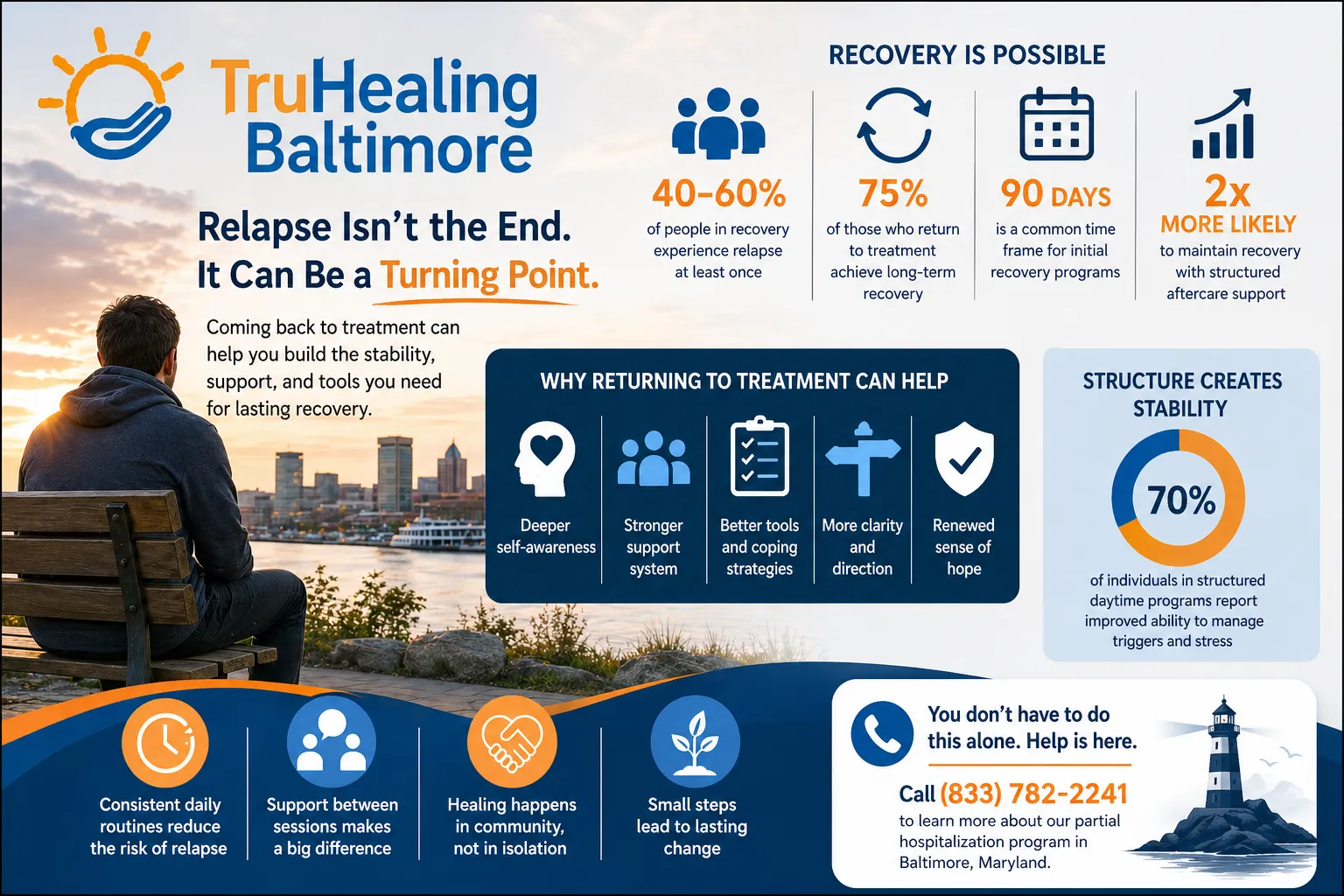
No. It means you’re still trying. Relapse is something many people experience—it doesn’t erase your progress or your ability to recover.
Will it feel the same as the first time?
Some parts might feel familiar, but your experience can be completely different. You’re coming back with more awareness, which changes how you engage.
What if I’m embarrassed to come back?
That feeling is common—but it usually fades quickly. Most people in treatment understand how hard it is to return, and there’s less judgment than you expect.
How do I know if I need more structure this time?
If things started to unravel between sessions or you felt unsupported during the gaps, more structured care might help create stability.
Is it normal to feel unsure about trying again?
Yes. Almost everyone feels unsure. You don’t need certainty—you just need enough willingness to take one step.
What if I leave again?
That fear makes sense. But this time isn’t about guaranteeing the outcome—it’s about giving yourself a different kind of support than you had before.
Can treatment actually work after relapse?
Yes. For many people, it works better the second time because they’re more honest and more aware of what they need.
You’re not the only one who said, “I already tried that.”
You’re not the only one who had to come back and figure it out differently.
And you don’t have to do it alone this time.
Call (833) 782-2241 to learn more about our partial hospitalization program in Baltimore, Maryland.