

We meet people like you all the time.
Not because things have completely fallen apart—but because they haven’t. Because you’ve managed to keep your life moving, your responsibilities intact, your image steady.
And still… something doesn’t feel right anymore.
Most people don’t start by searching for “treatment.” They start by trying to understand what’s happening to them. They look for something that fits their life—something like an intensive outpatient program—because the idea of stepping away from everything feels impossible.
So they keep going.
Until the evenings start to say more than the daytime ever will.
The version of you everyone sees is still functioning
From the outside, nothing about your life necessarily signals a problem.
You’re working. Showing up. Responding. Following through.
People rely on you—and you don’t let them down.
That’s part of what makes this so confusing.
Because the version of you that the world sees doesn’t match what’s happening internally.
There’s no dramatic moment. No clear breaking point.
Just a quiet, steady tension between “I’ve got this” and “I don’t feel okay.”
And when you’re high-functioning, it’s easy to stay in that tension for a long time.
Evenings feel different—and you’ve noticed it
It’s not just drinking.
It’s the role it plays.
The way your body starts anticipating it before the day is even over.
The way it marks the transition from “holding it together” to “finally letting go.”
At first, it probably felt harmless.
A way to relax. A reward. A routine.
Now it feels more automatic than intentional.
You might find yourself thinking:
- “I won’t drink tonight”… and then doing it anyway
- “Just one or two”… but it rarely stops there
- “Tomorrow will be different”… but it repeats
And the hardest part?
You’re aware of it.
That awareness doesn’t always lead to change—but it does create friction. And that friction builds.
You’re not in denial—you’re in conflict
A lot of people assume that if you’re still functioning, you must not see the issue clearly.
But that’s not what we see.
We see people who are fully aware… and still stuck.
Because awareness doesn’t automatically create a path forward.
Instead, it creates questions:
- Is this “bad enough” to do something about?
- What would people think if I asked for help?
- Do I really need something like rehab?
And underneath all of that:
- What happens if I try to change and fail?
So instead of acting, many people stay in a loop of negotiating with themselves.
Not because they don’t care—but because they don’t know what a realistic next step looks like.
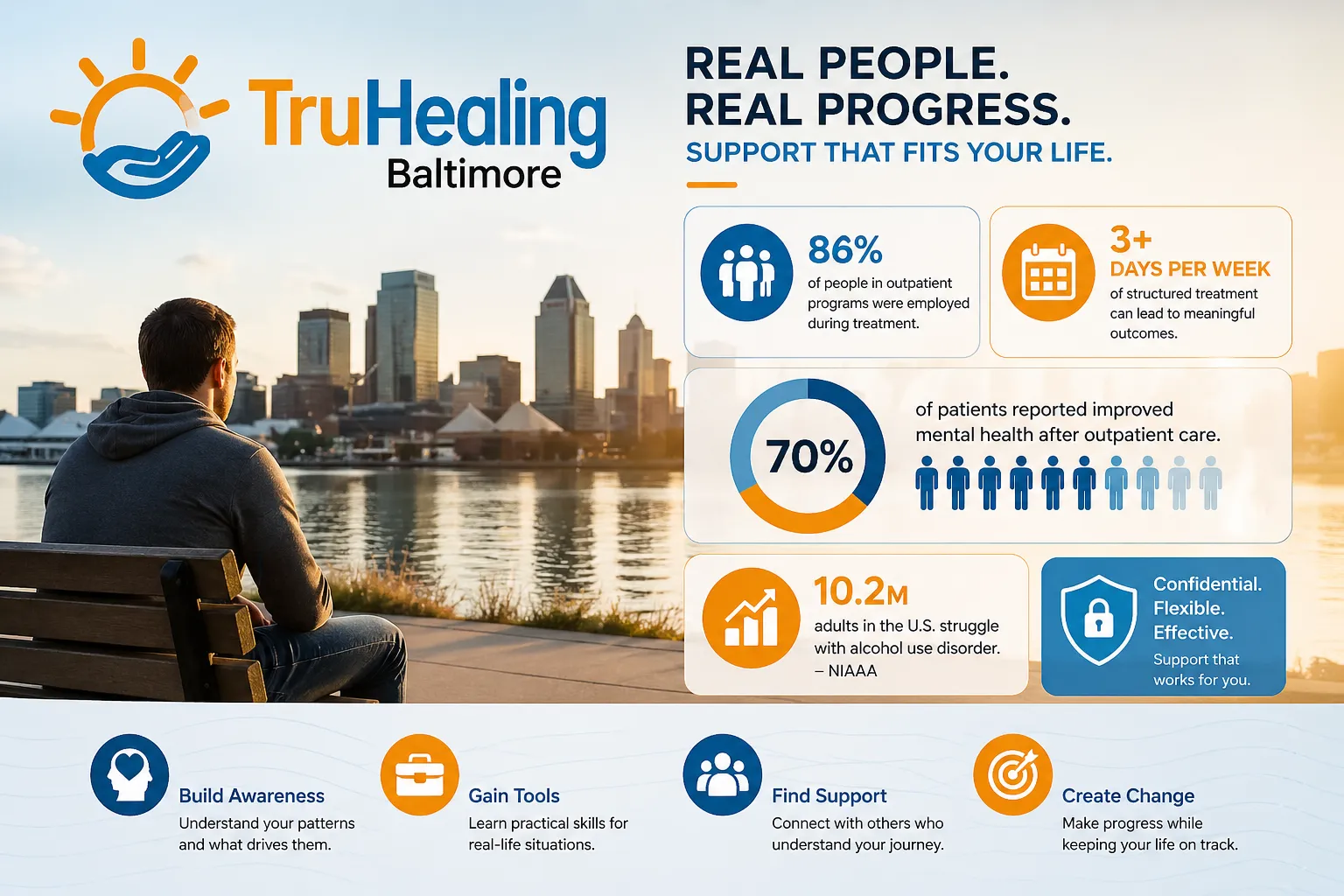
You don’t want to disappear from your life to get help
This is one of the biggest barriers we hear.
You’re not willing—or able—to step away from work, family, or responsibilities.
And the idea of “rehab” feels like disappearing from your life entirely.
For someone who’s built stability, that can feel like too much to risk.
But here’s what often gets missed:
Not all support requires you to leave your life behind.
There are structured options that work within your schedule—support that meets you where you are instead of pulling you out of everything you’ve built.
That’s where many people begin exploring outpatient alcohol help Baltimore resources.
Not because they’ve hit a breaking point—but because they’re trying to prevent one.
High-functioning doesn’t mean unaffected
There’s a cost to holding everything together.
It just doesn’t always show up in obvious ways.
It can look like:
- Mental fatigue that doesn’t go away
- Irritability that feels out of character
- Difficulty being present, even when you’re physically there
- A constant low-level guilt or unease
You might still be succeeding on paper.
But internally, it feels like you’re carrying something heavy that no one else can see.
That’s the part that wears people down.
Not the visible consequences—but the invisible ones.
What we notice in people like you
When people walk through our doors, there’s often a shared experience.
Not chaos. Not crisis.
Control.
People who’ve spent years managing everything so well that no one ever questioned it.
Until they started questioning it themselves.
We hear things like:
- “I didn’t think I belonged here”
- “I thought I had to be worse to ask for help”
- “I just got tired of doing this alone”
There’s a moment that happens—not dramatic, just quiet—where someone realizes they don’t have to keep carrying it all by themselves.
That moment matters.
Support doesn’t have to disrupt your entire life
There’s a version of help that fits into real life.
Something structured enough to create change—but flexible enough to respect your responsibilities.
That’s what multi-day weekly treatment is designed to offer.
You don’t have to leave your job.
You don’t have to explain everything to everyone.
You don’t have to “blow up” your life to rebuild it.
Instead, you start making adjustments while still living your day-to-day reality.
And for a lot of people, that’s what makes it possible to actually begin.
The quiet exhaustion is worth listening to
You might not be at a breaking point.
But you’re also not where you want to be.
And that matters.
Because the goal isn’t to wait until things get worse.
It’s to recognize that something already feels off—and to respond to that honestly.
Not with panic. Not with labels.
Just with curiosity and a willingness to explore something different.
Sometimes the most important shift isn’t dramatic.
It’s simply deciding not to ignore yourself anymore.
FAQs: The questions people don’t always ask out loud
Do I really need help if I’m still functioning?
Functioning doesn’t mean unaffected.
A lot of people who seek support are still working, maintaining relationships, and handling responsibilities. The question isn’t whether you’re functioning—it’s whether something feels unsustainable or out of alignment.
If it does, that’s worth paying attention to.
What if I don’t want to go to rehab?
That’s more common than you might think.
Many people start by looking for options that don’t require stepping away from their entire life. Structured outpatient support is often designed for exactly that reason—so you can get help without disappearing from your responsibilities.
How do I know if my drinking is actually a problem?
If you’re asking that question, it’s worth exploring.
It doesn’t have to meet a specific definition to matter. If it’s affecting your mood, your energy, your relationships, or your sense of control, that’s enough to take seriously.
What does support actually look like in real life?
It can look like having a consistent place to talk honestly.
Learning tools that apply to your actual day—not just theory.
Building awareness around patterns that feel automatic right now.
And doing all of that while still living your life.
What if I try to change and it doesn’t work?
That fear is real.
But trying doesn’t mean committing to a perfect outcome. It means giving yourself a different kind of support than what you’ve been doing alone.
And that alone can shift more than you expect.
Will people find out if I get help?
Not necessarily.
Many forms of treatment are designed to be private and flexible. You don’t have to share more than you’re ready to.
A lot of people get support quietly—and that’s okay.
You don’t have to wait for things to fall apart
If something in this feels familiar, it’s not random.
It’s your awareness catching up to your reality.
And you don’t have to ignore that.
There are options that meet you where you are—especially if you’re looking for treatment in Baltimore that fits into your life instead of pulling you out of it.
You’re allowed to take this seriously before it becomes something you can’t ignore.
Call (833) 782-2241 or visit our intensive outpatient program services in Baltimore, Maryland to learn more.