

You didn’t disappear because you didn’t care.
You stepped back because something didn’t fit, or something got heavy, or something inside you said, “I can’t do this right now.”
And now you’re here—quietly trying to figure out if coming back is even possible.
Not just emotionally, but practically.
Insurance is usually the first question.
If you’ve already started looking into something like an intensive outpatient program, then you’re not avoiding this anymore. You’re trying to understand your options.
And one of the biggest concerns sounds like this:
“Will my insurance still cover it if I try again?”
Let’s walk through that—step by step, without pressure.
Step 1: Start With What Insurance Actually Looks At
It’s easy to assume insurance works like a one-time pass.
Like you had your opportunity, and if you didn’t complete it, that door is closed.
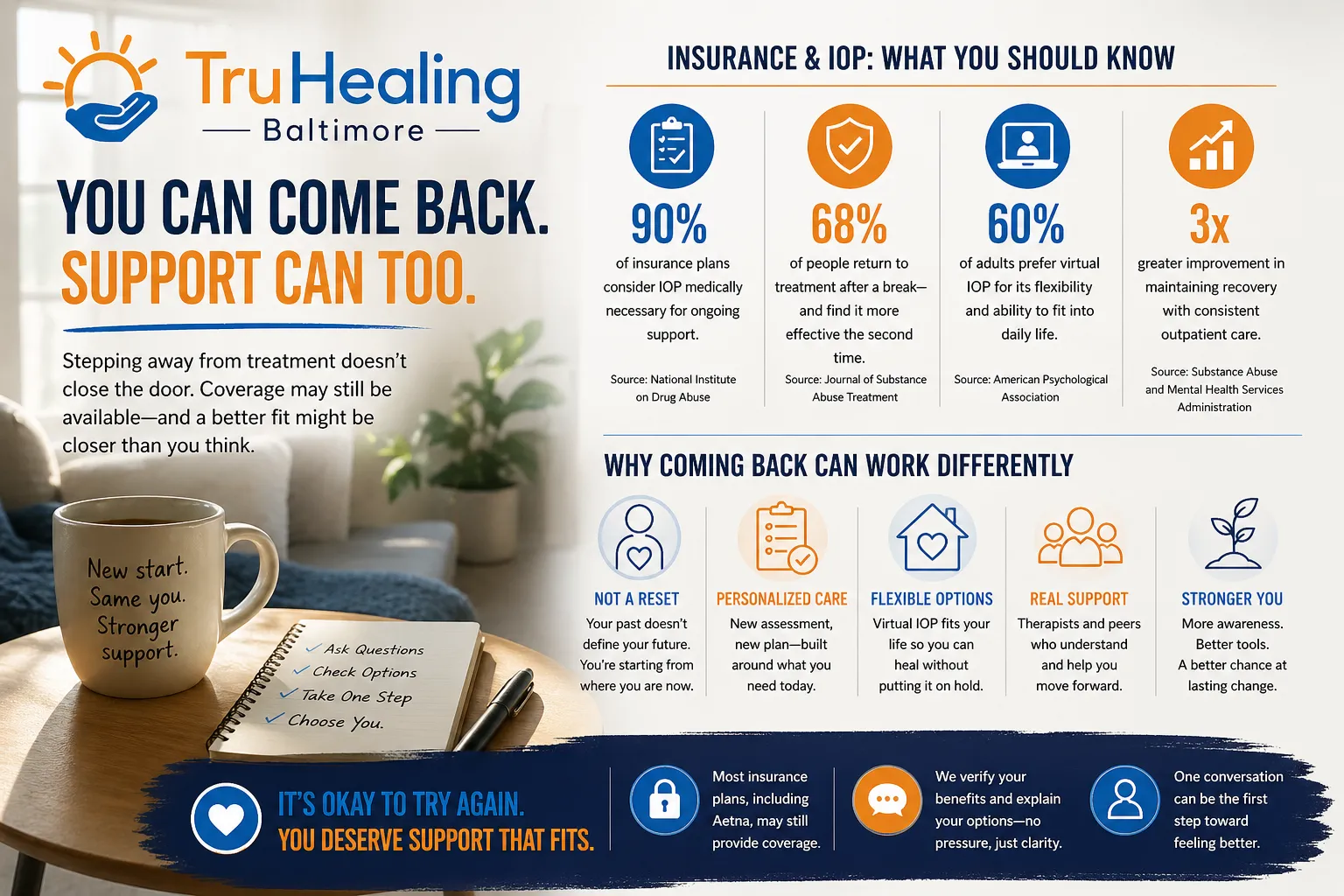
That’s not how most plans—especially ones like Aetna—actually work.
Coverage is usually based on your current situation, not your past attendance.
That means they look at:
- What you’re dealing with right now
- Whether support is still medically necessary
- How your symptoms are affecting your day-to-day life
They’re not grading you on whether you stayed last time.
They’re asking: Do you still need help?
And if the answer is yes, coverage is often still available.
Step 2: Understand That Leaving Doesn’t Cancel Your Options
There’s a quiet kind of shame that comes with stepping away from treatment.
Even if no one said anything to you directly, it can feel like:
“I didn’t follow through.”
“I probably wasted that chance.”
“They won’t take me seriously now.”
But leaving doesn’t cancel your access to care.
It just means something didn’t work at that moment.
Sometimes it was scheduling.
Sometimes it was emotional overwhelm.
Sometimes it just didn’t feel like the right fit yet.
That doesn’t disqualify you. It gives context.
And coming back isn’t repeating the same experience—it’s approaching it differently.
Step 3: Let Someone Else Check Your Benefits (You Don’t Have to Decode It)
Insurance language can feel like it was designed to confuse you.
Deductibles. Authorizations. Coverage limits.
It’s a lot—especially if you’re already feeling overwhelmed.
The good news is you don’t have to figure it out on your own.
Most treatment centers can verify your benefits directly. That means they:
- Contact your insurance provider for you
- Break down what’s covered and what’s not
- Explain any potential costs in plain language
- Help you understand your options without pressure
If you’ve been searching things like IOP insurance coverage Maryland, it’s usually because you’re trying to make sense of something complicated.
You don’t have to do that part alone.
Step 4: Expect the Process to Feel Different This Time
One of the biggest fears people carry is this:
“What if I go back… and it feels exactly the same?”
That fear makes sense.
But returning after stepping away usually changes the dynamic in a meaningful way.
This time, you’re not walking in blind.
You already know:
- What felt hard
- What didn’t click
- Where you struggled to stay engaged
That information matters.
It allows the approach to shift:
- More flexibility where you need it
- More honesty about resistance or hesitation
- More focus on what actually helps you stay present
You’re not expected to pretend it’s easy.
You’re allowed to say, “This is where I got stuck.”
And instead of that being a failure—it becomes the starting point.
Step 5: Consider Whether Virtual Support Solves What Didn’t Work Before
Sometimes it wasn’t the treatment itself that made things difficult.
It was everything around it.
The logistics.
The time commitment.
The pressure of physically showing up every day.
Virtual care removes a lot of that friction.
For many people in Baltimore and across Maryland, being able to attend from home changes everything.
It allows you to:
- Stay consistent without rearranging your entire life
- Reduce the stress of commuting or scheduling conflicts
- Feel more comfortable opening up in your own space
If you stepped away before because it didn’t fit your life, this version of care can feel much more doable.
Step 6: Take One Step—Not All of Them
This is where people often get stuck again.
They think reaching out means committing to everything all at once.
It doesn’t.
You don’t have to decide your entire treatment plan today.
You don’t have to promise you’ll finish anything.
You don’t even have to be sure you’re ready.
You just have to take one step:
Ask a question.
Check your coverage.
Have a conversation.
That’s enough.
The Part That Feels Awkward (But Doesn’t Have To Be)
A lot of people worry about how it will feel to come back.
Like they’ll have to explain where they went.
Like someone will question their commitment.
Like they don’t belong anymore.
That’s not the reality.
People step away from care all the time.
Life gets complicated. Emotions get intense. Timing doesn’t always line up.
Coming back isn’t unusual—and it’s not something you have to justify.
You’re allowed to return without a long explanation.
You’re allowed to pick up where you are, not where you think you “should” be.
You’re Not Starting Over—You’re Starting With More Awareness
There’s a difference.
Starting over feels like everything was lost.
Starting again means you’re bringing something with you:
- More honesty about what you need
- More clarity about what doesn’t work
- More willingness to ask questions
Even if it doesn’t feel like progress, it is.
Because this time, you’re not guessing.
You’re choosing.
FAQs: Honest Answers About Insurance and Coming Back
Does Aetna usually cover returning to treatment?
In many cases, yes. Coverage is typically based on current medical need, not whether you completed a program before. If support is still necessary, coverage may still apply.
Will I need a new assessment?
Usually, yes. A new assessment helps determine what level of care fits your current situation. It’s not about judging the past—it’s about understanding where you are now.
What if I left treatment without telling anyone?
You can still come back. There’s no penalty for stepping away. The focus is on helping you move forward, not questioning why you left.
Is virtual care covered the same way as in-person care?
Often, yes. Many insurance plans now include virtual options, especially for structured outpatient support. Coverage specifics depend on your plan, but it’s commonly included.
What if I’m worried about cost?
That’s a valid concern. Benefit verification helps clarify what your insurance will cover and what, if anything, you’d be responsible for. You’ll have that information before making decisions.
Do I have to commit long-term right away?
No. Starting the process doesn’t lock you into anything. It opens the door to understanding your options and deciding what feels right.
What if I’m still unsure about coming back?
That’s okay. Most people feel unsure. You don’t have to be fully ready—you just have to be willing to explore what support might look like.
Can treatment actually feel different the second time?
Yes. Many people find it more effective the second time because they come in with more awareness and honesty about what they need.
You don’t need to have done it perfectly the first time.
You don’t need to explain everything before you reach out.
You just need a place to begin again—without pressure, without judgment.
Call (833) 782-2241 to learn more about our intensive outpatient program in Baltimore, Maryland.