

Ninety-three days.
That’s the number that kept repeating in my head.
Ninety-three days sober.
Ninety-three days of rebuilding trust.
Ninety-three days of waking up without shame.
Then one night, it was gone.
Or at least I thought it was.
I remember sitting alone afterward, convinced that I had thrown away everything I worked for. I wasn’t thinking about treatment. I wasn’t thinking about recovery. I wasn’t thinking about what came next.
I was thinking about hiding.
That’s what relapse did to me.
Not immediately. The substance came first. The hiding came next.
I stopped answering calls. I ignored texts. I avoided people who cared about me. Every day that passed made it harder to reach back out.
Maybe you’re somewhere in that place right now.
Maybe you’re searching for treatment options and insurance information because part of you knows you need support, but another part feels embarrassed that you’re even looking.
If that’s you, I want to tell you something I didn’t believe when I relapsed:
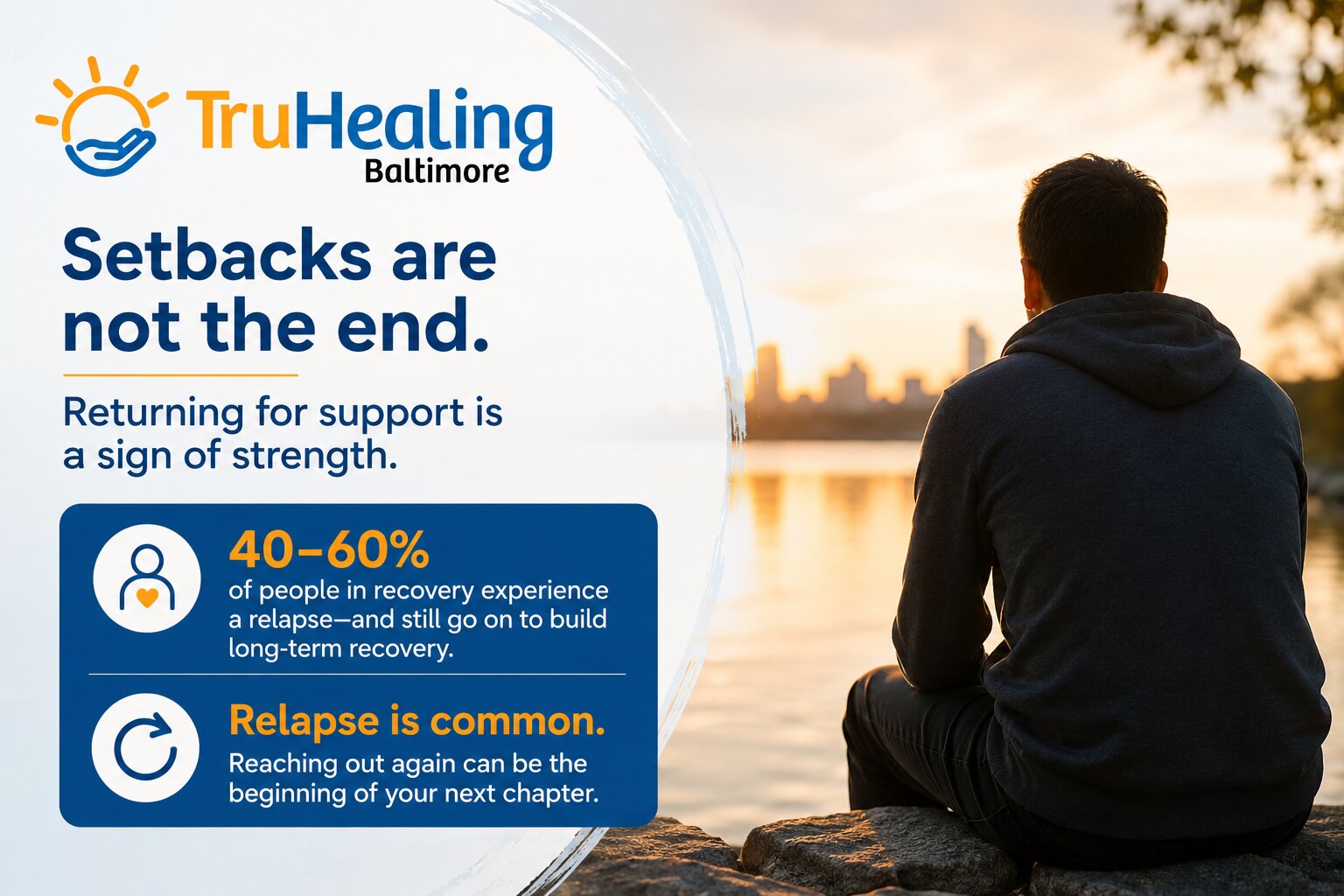
A setback is not the same thing as starting over.
And asking for help again is not proof that you failed.
If you’re exploring treatment options and wondering what level of support might help you regain your footing, learning about live-in treatment support can be one step toward understanding what recovery can look like after a difficult chapter.
The Relapse Hurt. The Shame Hurt More.
People often focus on the relapse itself.
The drink.
The pills.
The return to old behaviors.
But for me, that wasn’t the hardest part.
The hardest part was what happened afterward.
I started rewriting my entire story.
Instead of seeing ninety-three days of progress, I saw one mistake.
Instead of recognizing everything I had learned, I focused on everything I thought I had ruined.
Shame has a way of shrinking your perspective.
It takes a full picture and reduces it to a single moment.
It tells you that one bad night defines your entire recovery.
It convinces you that people will only see your failure.
Most importantly, it convinces you that you’re alone.
That’s why relapse can become so dangerous.
Not because of the event itself.
Because of the isolation that follows.
I Thought Everyone Would Be Disappointed
One of the reasons I avoided asking for help was because I believed I knew what everyone else would think.
I imagined disappointment.
Frustration.
Judgment.
I assumed people would look at me and see wasted effort.
What I eventually discovered was something completely different.
Most people who understood recovery didn’t seem shocked.
They didn’t act like I had destroyed everything.
Many simply said some version of:
“Okay. What do you need right now?”
That question changed everything.
Because it shifted the focus away from punishment and toward support.
Recovery communities understand something important.
Relapse is painful.
But shame rarely helps people heal from it.
Recovery Is Not a Straight Line
I used to believe recovery worked like climbing a staircase.
One step after another.
Always moving upward.
Always progressing.
Reality looks different.
Recovery often looks more like a winding trail through the woods.
Sometimes you move forward quickly.
Sometimes you get lost.
Sometimes you take a wrong turn and spend time finding your way back.
The existence of a wrong turn doesn’t erase the distance you’ve already traveled.
Yet that’s exactly what many people believe after a relapse.
They assume every lesson disappeared.
Every skill vanished.
Every achievement became meaningless.
None of that is true.
The person who stayed sober for ninety days still exists.
The insight you gained still exists.
The growth still exists.
The relapse becomes part of the story.
It doesn’t become the whole story.
The Longer You’ve Been Sober, the Harder It Can Be to Ask for Help
This is something many alumni understand.
Early in recovery, asking for help feels expected.
Everyone knows you’re learning.
Everyone understands you’re vulnerable.
Months later, things change.
People assume you’re doing well.
You assume you should be doing well.
The pressure increases.
When struggles appear, they often feel harder to admit.
You think:
“I should know better.”
“I’ve already learned this lesson.”
“I shouldn’t need this much support.”
Those thoughts keep many people suffering in silence.
The truth is that recovery doesn’t eliminate the need for support.
It changes the type of support you may need.
Long-term wellness often depends on staying connected, not becoming completely independent.
Why People Start Searching for Insurance Information
On the surface, insurance questions seem practical.
Can I afford treatment?
Does Aetna cover this?
What are my options?
But in my experience, those questions often hide deeper concerns.
Questions like:
“Am I worth helping again?”
“Will anyone take me seriously?”
“Is there still a place for me in recovery?”
I remember spending hours researching insurance and treatment programs online.
Not because I was ready to call.
Because searching felt safer than asking.
Information created distance.
A phone call felt real.
Eventually, I learned something important.
Most treatment providers understand that insurance questions are part of a much larger conversation.
Coverage depends on your individual plan, provider network, medical necessity criteria, and other factors. The best way to understand your options is usually through a direct conversation with a treatment provider who can verify benefits and discuss potential next steps.
Sometimes You Need More Than Willpower
I spent a long time believing determination could solve everything.
If I wanted recovery badly enough, I thought I’d be okay.
If I tried harder, I’d be okay.
If I became more disciplined, I’d be okay.
The problem was that I treated recovery like a character test.
I thought struggling meant I lacked commitment.
I thought asking for more support meant I wasn’t strong enough.
Eventually, I realized that recovery isn’t about proving strength.
It’s about creating conditions where healing becomes possible.
For some people, that means additional counseling.
For others, support groups.
For others, a higher level of care.
Many people exploring inpatient rehab Baltimore options aren’t looking for an easy way out.
They’re looking for a safe way forward.
Those are very different things.
What Happened When I Reached Out Again
The phone call wasn’t dramatic.
There was no movie moment.
No sudden breakthrough.
Just a conversation.
A simple conversation that reminded me I wasn’t the first person to come back.
That mattered.
Because shame tells you you’re uniquely broken.
Support reminds you that you’re human.
I wasn’t welcomed back because I had earned another chance.
I was welcomed back because recovery communities understand something most people forget:
People often need more than one chapter.
Sometimes they need more than one beginning.
You Are More Than Your Worst Day
If you’ve relapsed recently, it’s easy to define yourself by that experience.
To see yourself as the person who messed up.
The person who lost progress.
The person who disappointed everyone.
But people are bigger than their worst moments.
You are bigger than yours.
The version of you who wanted recovery still exists.
The version of you who worked hard still exists.
The version of you who believed life could be different still exists.
That person deserves support too.
Not after you prove yourself.
Not after you suffer enough.
Now.
Frequently Asked Questions
Does a relapse mean treatment didn’t work?
No. Relapse can happen for many reasons and does not automatically mean treatment failed. Many people use what they learned during treatment to re-engage in recovery after a setback.
Can I return to treatment if I’ve been there before?
Absolutely. Many people return to treatment after a relapse. Recovery is often a process that includes multiple stages, adjustments, and opportunities for growth.
Does Aetna cover addiction treatment?
Coverage varies depending on the specific Aetna plan, provider network, medical necessity requirements, and other factors. Speaking directly with a treatment provider can help clarify available benefits.
Should I seek help immediately after a relapse?
Every situation is different, but many people benefit from reaching out sooner rather than later. Early support can help prevent a setback from becoming a larger crisis.
Why do I feel so ashamed after relapsing?
Shame is a common response to relapse, especially for people who have invested significant effort into recovery. However, shame often makes it harder to seek help, which is why connection and support are so important.
What if I’m afraid people will judge me?
Many people entering treatment after a relapse share this fear. In reality, treatment professionals and recovery communities often understand relapse as part of many people’s recovery experiences.
How do I know if I need a higher level of care?
If you’re struggling to stay safe, repeatedly returning to substance use, or feeling unable to regain stability on your own, it may be helpful to discuss treatment options with a professional.
You Don’t Have to Stay Hidden
The biggest difference between my relapse and my recovery wasn’t perfection.
It was connection.
One path kept me isolated.
The other brought me back to people who understood.
If you’re carrying shame, uncertainty, or fear about asking for help again, know this:
Your story didn’t end with a relapse.
It may simply be asking for a new chapter.
Call (833) 782-2241 or visit our residential treatment program services to learn more about our treatment programs and residential treatment programs services Baltimore County, Maryland.