


I remember sitting in a parking lot after work, staring at my steering wheel longer than usual.
Not because I didn’t know where to go. I knew exactly where I was headed.
Home. Dinner. Emails. Maybe a drink. Maybe several.
Then I’d wake up the next day and do it all over again.
From the outside, I looked successful. I showed up. I paid my bills. I met deadlines. Nobody would have pointed at me and said I needed treatment.
But I was tired in a way that sleep couldn’t fix.
The hardest part wasn’t admitting I needed help. The hardest part was believing I could get help without losing everything I’d worked for.
If you’re researching treatment and wondering whether you’ll be able to keep your job, maintain your responsibilities, and still get the support you need, you’re asking one of the most common questions people ask before entering care.
That’s why understanding your options matters. Learning more about an intensive outpatient program can help you understand how treatment may fit into a life that’s already full of obligations.
The People Who Ask This Question Usually Aren’t Falling Apart
One thing that surprised me was realizing how many people entering treatment looked a lot like me.
They had careers.
They had families.
They coached their kid’s soccer team. Managed departments. Owned businesses. Paid mortgages.
The stereotype of addiction tells us that treatment is only for people whose lives have completely collapsed.
Real life is usually more complicated.
Many people seek help while they’re still functioning at a high level. In fact, that’s often why the decision feels so difficult. There isn’t always a dramatic crisis forcing action.
Instead, there’s a growing awareness that something isn’t sustainable.
You start noticing how much energy goes into holding everything together.
You realize you’re constantly recovering from the previous night, managing anxiety, hiding habits, making promises to yourself, and carrying stress that nobody else can see.
The problem isn’t always visible from the outside.
It’s visible in the exhaustion.
The Fear of Treatment Is Often Really About Control
Most high-functioning professionals don’t fear support itself.
They fear losing control of their schedule.
Control of their income.
Control of their reputation.
Control of the identity they’ve spent years building.
Questions start running through your mind:
Will my employer find out?
Will I need to take leave?
Will treatment interfere with meetings?
What happens to my clients?
What about my family?
What if I can’t keep up?
These concerns are real. They deserve honest answers.
The good news is that treatment isn’t a one-size-fits-all experience. Different levels of care exist because different people have different needs, responsibilities, and recovery goals.
The right treatment plan takes your clinical needs seriously while also considering the realities of your life.
Sometimes the Schedule Matters Less Than the Support
When people search for PHP vs IOP, they’re usually trying to figure out how treatment fits into a work schedule.
That’s understandable.
But focusing only on hours can cause you to miss the bigger question.
What level of support gives you the best chance to actually recover?
Think about it this way.
If someone has a broken leg, the goal isn’t choosing the treatment option that takes the least time. The goal is choosing the option that helps the injury heal correctly.
Recovery works similarly.
Some people benefit from structured daytime care because they need a higher level of support, accountability, and therapeutic engagement.
Others can safely participate in multi-day weekly treatment while continuing to manage work and personal responsibilities.
Neither option is better.
They’re simply designed for different situations.
A quality clinical assessment helps determine which level of support is most appropriate based on your specific circumstances.
Trying to White-Knuckle It Has a Cost
High-functioning people often become experts at pushing through discomfort.
That skill probably helped you succeed professionally.
It may also be keeping you stuck.
Many of us convince ourselves that if we can still perform, the problem can’t be that serious.
But performance and wellness are not the same thing.
You can hit your targets and still be struggling.
You can receive promotions and still feel trapped.
You can look successful while privately feeling exhausted, isolated, and overwhelmed.
The hidden cost often shows up in places that don’t appear on a performance review:
- Constant anxiety about being discovered
- Poor sleep
- Difficulty being emotionally present
- Increased irritability
- Memory problems
- Burnout
- Relationship strain
- Physical health concerns
At some point, managing the problem becomes more exhausting than addressing it.
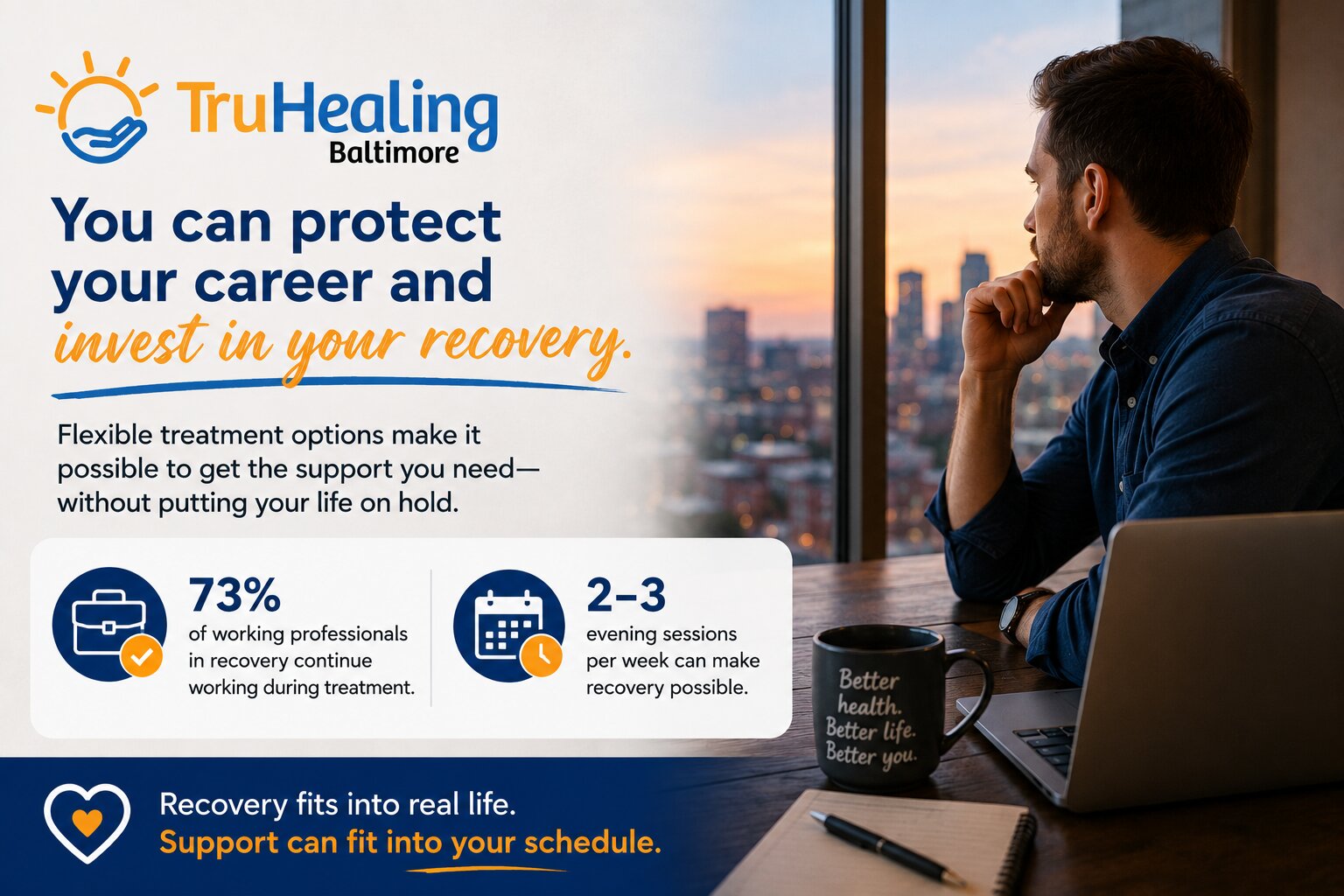
What Keeping Your Job Actually Looks Like During Treatment
One of the biggest misconceptions is that treatment automatically means disappearing from normal life.
For many people, that’s simply not the case.
Depending on clinical recommendations, treatment may be scheduled around work obligations.
Some people attend sessions during evenings.
Others adjust work schedules temporarily.
Some use available leave benefits while they stabilize and then transition into a more flexible level of care.
The experience looks different for everyone.
What’s important is recognizing that treatment planning often involves practical conversations about work, family obligations, transportation, and scheduling.
Recovery doesn’t happen in a vacuum.
Good programs understand that.
They know people still have lives to manage.
Why Early Action Creates More Options
There’s another reason this question matters.
The earlier you seek help, the more options you often have.
Waiting until a crisis occurs can reduce flexibility.
A DUI, job loss, medical emergency, disciplinary action, or major relationship breakdown may force decisions under pressure.
Seeking support before reaching that point often allows for a more thoughtful process.
You can evaluate programs.
Explore scheduling options.
Talk through concerns.
Create a plan.
Instead of reacting to a crisis, you’re making a proactive decision.
That’s a very different experience.
Recovery Doesn’t Take Away Your Ambition
A lot of professionals worry that treatment means stepping away from the goals they’ve worked hard to achieve.
What many discover is the opposite.
Recovery doesn’t remove ambition.
It removes obstacles.
The mental energy spent managing substance use can be redirected toward things that actually matter.
People often report improvements in:
- Focus
- Productivity
- Decision-making
- Communication
- Leadership
- Reliability
- Emotional resilience
The version of yourself that emerges in recovery isn’t usually smaller.
It’s often more capable because it’s no longer carrying so much hidden weight.
You Don’t Need to Wait Until Everything Falls Apart
One of the most damaging myths about addiction is the belief that you must hit rock bottom before getting help.
Many people never experience a dramatic collapse.
They simply reach a point where they’re tired of living in survival mode.
If you’re reading this, chances are something inside you already knows the current situation isn’t working.
You don’t need permission to address it.
You don’t need to prove you’re struggling enough.
You don’t need to lose your career, family, or future before seeking support.
You can choose help because you want a better life.
That’s enough.
Frequently Asked Questions
Can I work while receiving treatment?
Many people continue working while participating in treatment, depending on their clinical needs and the level of care recommended. Treatment providers can often help create a schedule that balances recovery and professional responsibilities.
Will my employer know I’m in treatment?
Privacy laws protect much of your healthcare information. Specific circumstances vary, but many people receive treatment without sharing detailed information with their employer. A treatment provider can help explain confidentiality protections.
How do I know which level of care is right for me?
The best way to determine the appropriate level of care is through a professional assessment. Recommendations are based on factors such as substance use history, mental health needs, physical health concerns, relapse risk, and personal responsibilities.
What if I can’t take time away from work?
Many people initially feel this way. Exploring treatment options can help clarify what is realistically possible. In some cases, flexible scheduling or outpatient treatment allows individuals to receive support while maintaining employment.
Is it better to wait until things get worse?
Generally, early intervention creates more opportunities and flexibility. Seeking help before a major crisis develops can make the treatment process less disruptive and more manageable.
What if I’m still functioning well?
Many people entering treatment are still functioning professionally and socially. The question isn’t always whether you’re functioning. It’s whether you’re living the life you want and whether your current situation is sustainable long term.
A Conversation Can Bring More Clarity Than Another Month of Guessing
You don’t have to figure this out by yourself.
If you’re trying to understand your options and determine what level of care fits your responsibilities, a conversation with a professional can provide clarity without pressure.
Call (833) 782-2241 or visit our intensive outpatient program services to learn more about our treatment programs and intensive outpatient program services Baltimore County, Maryland.