

You know the difference between a bad week and something deeper.
You can feel it in your body.
The tension in your chest when they don’t answer.
The way your sleep has become lighter.
The constant mental math — Are they safe? Are they using? Is this getting worse?
If you’re quietly asking whether something more structured — like live-in treatment in Baltimore — might be necessary now, that question is not dramatic.
It’s protective.
As a clinician, I want to walk you through the signs that suggest your adult child may need a higher level of care — not to alarm you, but to steady you.
You deserve clarity.
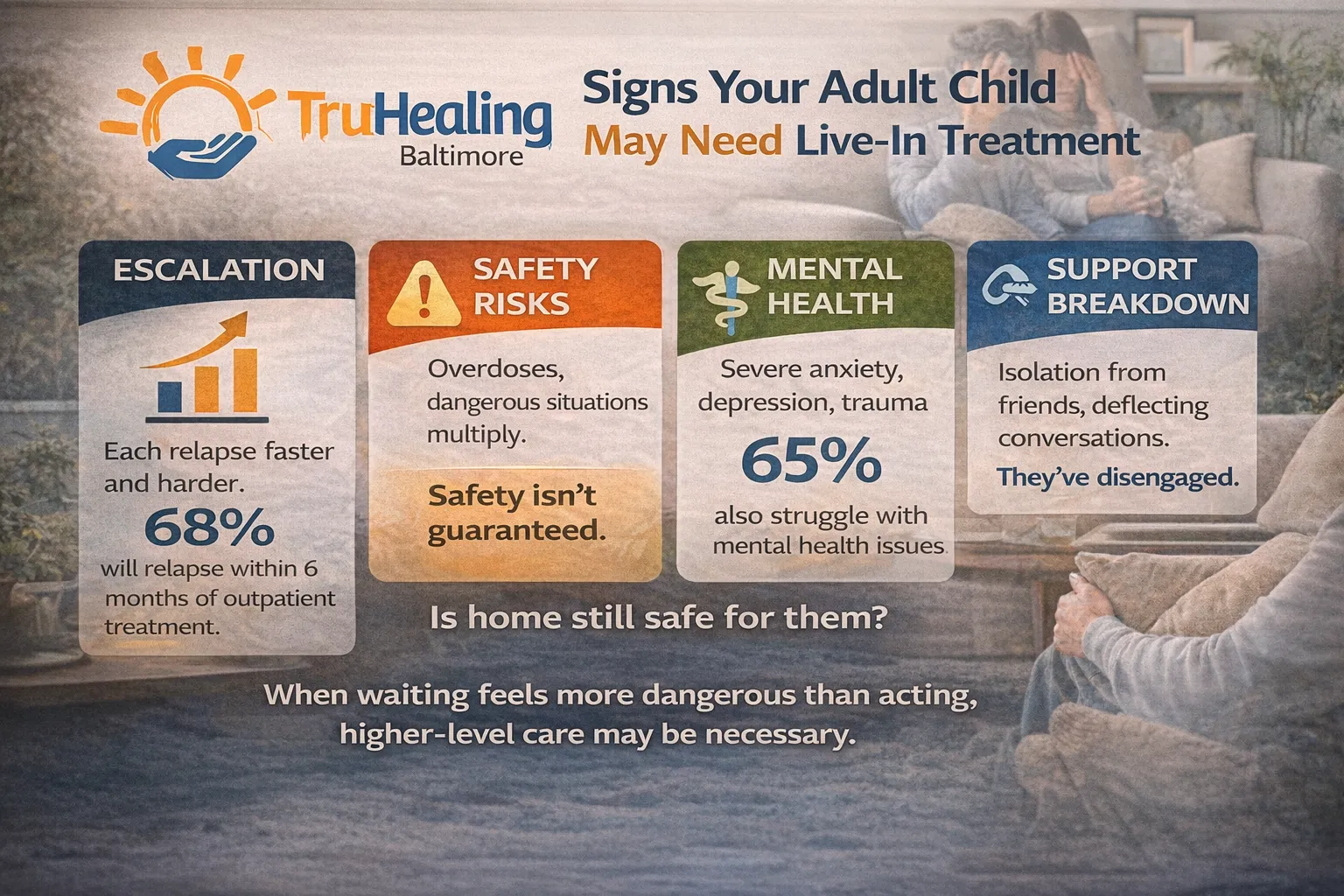
The Pattern Isn’t Just Repeating — It’s Escalating
Relapse in young adults often starts subtly.
Missed classes.
Mood swings.
Borrowed money.
Excuses that sound polished but thin.
But escalation has markers.
The time between episodes shrinks.
The consequences intensify.
The recovery periods get shorter and more fragile.
If you’re noticing that each cycle hits harder than the last, that’s not a coincidence.
Addiction rarely stabilizes on its own.
Progression is predictable when intervention stays the same.
Safety Is No Longer Assured
This is one of the clearest signals.
If your adult child is:
- Driving under the influence.
- Mixing substances.
- Experiencing overdoses or medical scares.
- Associating with unsafe people.
- Expressing hopelessness or suicidal thinking.
Safety becomes the priority — not independence.
Round-the-clock support exists for this reason.
It’s not about punishment.
It’s about containment during instability.
When parents from Howard County, Maryland call us in this stage, the exhaustion in their voice is unmistakable. They’re not trying to control their child. They’re trying to keep them alive.
That distinction matters.
Every Attempt at “Moderation” Collapses
Young adults often sincerely believe they can regain control.
They promise:
“I won’t touch that again.”
“I’ll only use on weekends.”
“I’ve learned my lesson.”
But if each attempt at moderation ends in the same pattern — secrecy, escalation, regret — that’s important data.
A residential treatment program creates a full interruption.
Without access. Without enabling. Without daily triggers.
That interruption allows the brain to stabilize enough for real therapeutic work to begin.
Moderation attempts that repeatedly collapse are not moral failures.
They’re neurological realities.
When Mental Health and Substance Use Intertwine
Very few 20-year-olds struggling with addiction are only dealing with substances.
Often underneath is:
- Untreated anxiety.
- Depression that drains motivation.
- Trauma that hasn’t been spoken aloud.
- ADHD that fuels impulsivity.
- Shame that feels unbearable.
When mental health and substance use collide, outpatient care sometimes isn’t enough.
You may notice:
- Extreme irritability.
- Emotional numbness.
- Panic attacks.
- Isolation.
- Volatile relationships.
If your child’s substance use is tightly woven into their emotional instability, they likely need immersive care where both are addressed together.
Trying to untangle them separately rarely works.
They’ve Disconnected From Support Systems
Withdrawal can be quieter than relapse.
They stop attending therapy.
They avoid sober peers.
They isolate in their room.
They deflect every serious conversation.
Parents often describe it as “losing access” to their child.
The door is closed more often.
The answers get shorter.
Eye contact disappears.
Isolation is fuel for addiction.
Live-in treatment replaces isolation with structured community.
That shift alone can change momentum.
Your Household Feels Like Crisis Management
Parents minimize their own distress constantly.
But here’s what I listen for:
Are you checking their location at night?
Are you sleeping with your phone on loud?
Are you monitoring their tone of voice for warning signs?
Are you rearranging your life to prevent the next explosion?
If your nervous system is permanently on alert, that’s not sustainable.
Families from Carroll County, Maryland often describe feeling like they’re walking through their own home on eggshells.
That kind of hypervigilance is a signal.
When the entire family system becomes organized around one person’s instability, higher-level care may be necessary.
They Say They Want Help — But Can’t Follow Through
This is one of the most painful scenarios.
They cry.
They admit they’re struggling.
They say, “I need help.”
Then days later, they use again.
This isn’t always manipulation.
Addiction disrupts executive functioning — the ability to translate intention into action.
They may genuinely want help.
But without structure, intention gets overpowered by impulse.
Round-the-clock support bridges that gap.
It holds the structure steady when they cannot.
The Progress After Outpatient Care Has Stalled
If your child has already tried therapy, outpatient programs, or structured daytime care — and progress keeps collapsing — that’s important.
It doesn’t mean they’re hopeless.
It may mean the level of care hasn’t matched the severity of the pattern.
A residential treatment program offers immersion.
Distance from triggers.
Constant therapeutic oversight.
Integrated psychiatric support.
Peer accountability.
For some young adults, that intensity is what finally breaks the cycle.
A Story That Might Feel Familiar
We worked with a 22-year-old whose parents felt torn.
They worried that pushing for live-in treatment would damage trust.
He had relapsed twice after outpatient therapy. Each time, he insisted he could manage it alone.
The turning point wasn’t a catastrophic event.
It was his mother saying, calmly, “I can’t keep pretending this is working.”
He entered treatment reluctantly.
Within weeks, deeper anxiety patterns surfaced — untreated and long-standing.
With consistent therapy and structure, he began building coping skills he had never fully practiced.
His parents didn’t lose him by choosing structure.
They interrupted a trajectory that was accelerating.
Hope often looks like structure at first.
Questions Parents Ask — And Deserve Honest Answers
Am I Overreacting?
Parental intuition is powerful. If your sleep is disrupted, your anxiety is rising, and patterns are repeating, you are not imagining things. Overreaction is panic without pattern. You’re observing pattern. That’s different.
What If They Refuse?
You cannot force internal willingness. But you can set boundaries around what you will support. Clear, consistent boundaries often create the conditions where treatment becomes the most viable option. A clinician can help you plan that conversation carefully.
Will This Ruin Our Relationship?
Temporary anger is common. But enabling instability often erodes relationships more deeply over time. Safety sometimes requires short-term tension. Healthy structure can rebuild trust later.
What If They’ve Tried Treatment Before?
Treatment is not one-size-fits-all. A different stage of progression may require a different level of care. Previous attempts do not eliminate future success. In fact, prior exposure often increases readiness.
How Do I Know This Isn’t Just “Being 20”?
Young adulthood includes experimentation. But sustained harm, escalating consequences, emotional instability, and repeated collapse are not typical developmental phases. When behavior consistently disrupts functioning and safety, it’s more than immaturity.
How Do I Manage My Own Guilt?
Almost every parent carries it. You replay conversations. You analyze past decisions. You wonder what you missed. Addiction is complex and multifactorial. It is not caused by one parenting mistake. You did not create this alone. And you cannot resolve it alone. But you can act with clarity now.
When Waiting Becomes Riskier Than Acting
Parents delay because they hope.
Hope is beautiful.
But hope without strategy can become avoidance.
If you’re seeing:
- Escalation.
- Increasing danger.
- Repeated collapse after promises.
- Worsening mental health.
- Household instability.
Waiting may increase risk.
Acting doesn’t mean giving up.
It means refusing to gamble with safety.
If you believe your adult child may need a residential treatment program now, you do not have to navigate that decision alone.
Call (833) 782-2241 to learn more about our Residential treatment program in Baltimore, Maryland.